 Released: December 25, 2005
Director: Terrence Malick; Screenplay: Terrence Malick; Cinematography: Emmanuel Lubezki; Studio: New Line Cinema; Producers: Sarah Green and Terrence Malick
Cast: Colin Farrell (Captain John Smith), Q’Orianka Kilcher (Pocahontas), Christopher Plummer (Captain Christopher Newport), Christian Bale (John Rolfe), August Schellenberg (Chief Powhatan), Wes Studi (Opchanacanough), Yorick van Wageningen (Captain Argall), Raoul Trujillo (Tomocomo), Michael Greyeyes (Rupwew), Irene Bedard (Pocahontas’ Mother), Kalani Queypo (Parahunt)
“How much they err,
that think every one which has been at Virginia
understand or knows what Virginia is.”
This film and the experience I had watching it for the first time is unlike anything I’ve ever felt from a movie. I talked about the incredible feeling I had after viewing Mulholland Dr. and how the enigmatic nature of it left me endlessly fascinated. This is different. There, I was intrigued by the story, wondering if I could put all of the pieces together and try to understand how it played out. With The New World, it was an all-encompassing, overwhelming onslaught of all the senses. I doubt that I’m even eloquent enough to put the feeling into words. It had then, and still has to this day, the ability to put me in a trance-like state whenever I watch it. The photography is stunningly beautiful, possibly the most impressive I’ve ever seen. The music is sublime, perfectly capturing the moods experienced throughout the film. The direction is lyrical, like watching a director write a poem through images. I just become completely immersed in the world that Terrence Malick creates.
This will be an interesting write-up, as so much of what I am attempting to communicate has to be experienced to be appreciated. And at times it might read like something of a love letter, which will be interesting for a lot of folks because I’m almost certain that some readers will completely abhor this film. I’ve been anxious to reach this year in the countdown so I could try to get down some thoughts on this movie, and also because I am eager to see if there are others that are as enamored by it as I am.
In the last few years of the countdown, I mentioned that there are two more films that challenge Mulholland Dr. as my top film for the entire decade. That statement was actually a bit misleading, but only because I needed to at least maintain some kind of suspense. The truth of the matter is this: although Mulholland Dr. and a future entry in this countdown come close, The New World is my #1 for all of the 2000s. And if I were to try to make an all-time list, it would place very, very high. I’m talking Top 10 or higher. I love this film that much. My guess is that whether someone cares for The New World is dependent upon their overall feelings toward director Terrence Malick. The typical elements of a Malick film are apparent – voiceover narration, loose and meandering storyline, and, most importantly, unmatched visual beauty. Where I am in regards to Malick overall is obvious and has been stated multiple times on the blog. With the exception of Badlands, I consider the other films on his resume to be bona fide masterpieces. But I’m of the opinion that The New World exceeds anything else that the famed recluse has done.
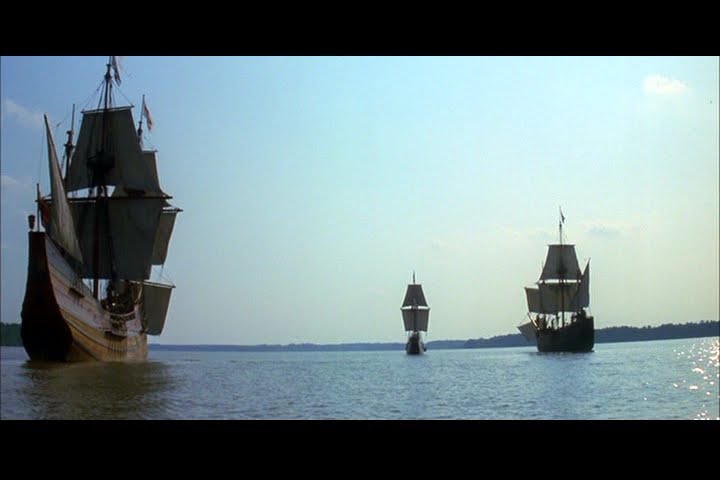
This is the story of the settlement of Jamestown, told through the often repeated myth of the romance that developed between Captain John Smith (Colin Farrell) and Powhatan princess Pocahontas (Q’Orianka Kilcher). Malick creates a world that is a blend of documented history and folklore. He pays strict attention to many historical details that add to a feeling of legitimacy – things like filming on location in a tributary of the James River and constructing complete replicas of the Jamestown settlement and Powhatan villages. A bevy of experts and consultants were hired to ensure that everything from style of dress, tools, and crops in nearby fields matched those used by natives of the time. The stickler Malick even hired a linguist and forced native actors to partially learn a dialect of Algonquin that, outside of a handful of natives and academics, had been extinct for nearly 200 hundred years. The result is an authenticity that is unmatched by similar historical epics. Perhaps some of these details could have been faked and the general audience would have been none the wiser. But the deliberation that was put into even the most minor details is obvious and it truly sells the idea that the production is as close to Jamestown in 1607 as any film can get.

Where the story diverges from the historical record is in the relationship between Smith and Pocahontas. There is no doubt that the two met each other in Jamestown, and by Smith’s own account she saved him from execution at the hands of Powhatan leaders. There is no evidence, however, that the two developed the kind of romantic relationship that has become legendary, repeated in everything from novels to Disney movies. None of this matters, though. I said it earlier in my review of JFK, but I still maintain that Roger Ebert was correct when he declared that facts belong in print, while movies are about emotions. Malick’s intention was never to make a movie that strictly adheres to documented fact. His films are about feelings. He set out to make a movie that examines what happens when cultures clash, how the passions of ordinary people can be subsumed by inexorable outside forces. And, in my opinion, to show the beauty that existed in both the people and the culture of natives long before being “civilized” by Europeans.

There are three cuts of the film that exist on various world releases, but in the States there are primarily two versions – the theatrical 125-minute release and the 175-minute extended cut. The differences between the two are just the ability of Malick to stretch in certain sequences, providing even more shots of the natural landscape. If I was recommending the film to a newcomer, I would say start with the theatrical release, then if you enjoy that move on to the expanded version. When I personally revisit the film, I almost always reach for the extended cut. But both versions have their worth, as certain sequences are edited a bit different in each cut, producing different responses when you watch them.
I don’t know that a plot synopsis of either version will help all that much for someone who hasn’t seen the film. So much of the story is seemingly random scenes that allow the viewer a window to simply observe the beauty of the land. I don’t even know how Malick wrote a screenplay for much of it. Things like Pocahontas dancing in wheat fields, natives examining the structure of shelters built by the colonists, or the complete lack of dialogue in large sections in favor of natural outdoor noises and the wonderful soundtrack. These are things that I can’t really describe; they simply have to been seen to understand what I am talking about. And they are not going to be for everyone – a lot of people who watch it will feel that the entire thing is wandering aimlessly from one pointless scene to the next. If that’s the case, I’m under no illusion of being able to convince anyone otherwise. But what I think this style does is convey the wonderment of the entire situation. Just stop and consider what it must have been like for two cultures, both essentially unaware of the other, to first make contact? Think about that. Imagine how the natives must have felt to see massive ships sailing into their harbors. Or the mix of excitement and terror that the English certainly experienced in trying to establish a colony in this foreign land. Malick’s imagery perfectly captures this astonishment. In such a situation, it would be impossible _not_ to stop and marvel at everything around you, and this is what Malick forces the viewer to do.

This means that plot and storyline ultimately takes a back seat to the visuals. But this in no way implies that there is not a compelling tale being told. There is an aching beauty in the relationship developed between Smith and Pocahontas. In watching it progress, I found it impossible not to also feel an inevitable gloom about it all. Farrell and Kilcher have such chemistry together that it only heightens the sadness surrounding a relationship that you know cannot work. The scenes near the end of the film, when the two are reunited in England after years of separation, are among the most melancholy I’ve seen. Kilcher was just 14-years old when shooting began on the film, which is probably the most shocking fact about the entire film. She turns in a performance that is mature well beyond her years. Farrell is very good and deserves credit for contributing to the dynamic between the two, but I never got the feeling that his role was one that couldn’t have been filled by many other actors. Kilcher’s performance, on the other hand, is singular. It has the elements of a great silent film performance, as the subtleties of tone of voice and body language are essential to putting it over. It is a remarkable film debut and I am not exaggerating at all in saying that it's among the finest performances that I've seen in a long time.

It cannot be forgotten, though, that this is a Terrence Malick film, meaning that no matter how strong the acting performances the true standouts remain those behind the camera. This fact alone is enough to turn off newcomers to his work, but I find something appealing about knowing that you’re watching an artist in complete control of what he is crafting. In Malick’s four major motion pictures, he hired a different cinematographer for each film. And yet in each case, he appears to best the amazing photography accomplished in his previous efforts. What this tells me is that regardless of who is his DP, Malick is a significant contributor in achieving the look of all of his films. In The New World he worked with one of the best in the business today, Emmanuel Lubezki. There are other outstanding achievements on Lubezki’s resume, but in my opinion not even the work he did in a film like Children of Men approaches the triumph achieved here. Lubezki and Malick decided to attempt to shoot the entire movie without artificial lighting, instead relying on the natural scenery and illumination of the Chickahominy River. In later interviews, Lubezki commented on the fact that he was terribly nervous about the proposition and often told Malick that he doubted they could pull it off. Malick was reassuring, telling his cinematographer that he wouldn’t have asked him to do it if he didn’t honestly believe that he had the ability. The decision to photograph the film was as important as the tactic of shooting during the “magic hour” in Days of Heaven. The result is a vibrant film, with visuals to rival something one would see on Discovery’s Planet Earth.
The soundtrack must also be acknowledged, if for nothing else than to recognize the disgusting amount of talent utilized by Malick in putting it together. James Horner was commissioned to write the entire soundtrack, but quickly ran into obstacles in working with the director. Due to Malick’s constant reshoots and edits, Horner was forced to continually write and rewrite the music for scenes. The result was a finished score that at times did not fit the flow of the film. Rather than reject it outright, Malick utilized it in parts, but in others inserted famed pieces from such musical luminaries as Richard Wagner and Mozart. Not a bad trio, eh? James Horner, one of the most renowned conductors of film scores, along with two of the most celebrated musicians who ever lived. Horner’s contributions are impressive, but the musical centerpieces are those from Wagner and Mozart. The use of Wagner’s prelude to Das Rheingold, particularly at the start of the film as the English ships are first entering Jamestown harbor, is the most fitting piece of music that could have been chosen. It goes perfectly with the theme of discovery. The second movement of Mozart’s Piano Concerto No. 23 is used to accentuate the more downbeat, mournful moments of the story. Just the opening notes of the piano in that piece are enough to make the hair stand up on the back of my neck.
I was originally concerned that this post would be shorter than usual, as I felt myself unable to articulate the power this movie has over me. Fortunately, no one has ever accused me of being into the whole brevity thing, and it felt good to finally pen something on a film that until this point I’ve hesitated to even really discuss. I recognize that this is not a film for everyone, but there are actually times that I like this to be the case, as it almost feels like I’m in on a secret that few others get. I’ll close in a way that I think is most befitting this film, by simply display some of the more spectacular images seen throughout. Even these beautiful screenshots don't do justice to a lot of the scenes.


Rating: 10/10
Other Contenders for 2005: After my gushing over The New World, it should be obvious that there is no other film that ever truly contended for the top spot. That being said, there are still a number of other films from this year that I think are outstanding. The first runner-up would have to be John Hillcoat’s Australian western The Proposition. It was a movie that I knew nothing about, outside of reading a random blurb that recommended it as a well-done modern western. It certainly lived up to that billing. Woody Allen’s Match Point might owe a lot to his earlier Crimes and Misdemeanors, and even more so to George Stevens’ A Place in the Sun, but it’s still an excellent thriller in its own right. I would probably rank it as Woody’s best film since Crimes and Misdemeanors. One movie that bombed upon its initial release, but was saved by the release of a director’s cut on DVD is Ridley Scott’s Kingdom of Heaven. I might rank it much higher than others, but I think in director’s cut form that it is a very good pop history epic. And being a major boxing fan, I have to admit to liking Cinderalla Man. It utilizes some of the usual sports clichés, but Paul Giamatti’s performance is more than enough to elevate it. Finally, I think that Steven Spielberg’s Munich works quite well in spots, but fizzles toward the end as Spielberg seems uncertain of the proper conclusion.
Arguably the two most highly acclaimed films of the year are ones that have never been particular favorites. My suspicion is that some will cite Ang Lee’s Brokeback Mountain as the best film of this year, but it never really worked for me. And I think that David Cronenberg’s A History of Violence is an average crime drama.


