Showing posts with label Ray. Show all posts

Thursday, June 3, 2010

#29: Nicholas Ray


- "That’s the obligation of the filmmaker or the theater worker – to give a heightened sense of experience to the people who pay to come to see his work."

Would it be cliché to open an entry on Nicholas Ray by marveling at how the French adored the mercurial director? Anytime a survey of Ray’s career is discussed, or analysis of his work attempted, it is mentioned that during the 1950s few American directors were held in such high regard at Cahiers du Cinema as Ray. Jean-Luc Godard in particular appeared to worship the man, once boldly declaring: “The cinema is Nicholas Ray.” At his best, I don’t know that I would necessarily argue with the sentiments of Godard and other leaders of the French New Wave. The sentiments expressed in Godard’s comment are justifiable considering the skills displayed in Ray’s moviemaking. In the hands of directors of lesser ability, a number of his films would play as little more that pulpy melodrama. As great as movies like They Live By Night and Rebel Without a Cause are, without Ray’s guidance I would argue that they would be average films at best.

Why was Ray able to transform potentially sappy material such as these (among others) and produce classics of American cinema? His visual storytelling, using the camera as an artist would a brush, is always impressive. But most importantly is the delicate way that he handled the themes that most interested him. Similar to how Howard Hawks would become a master at examining the bonds between men in nearly all of his greatest films, Nick Ray studied how outcasts managed to make their way in the world. The ability to convey an unrelenting sense of isolation permeates much of Ray’s work. Rather than being completely depressing, though, Ray also gives these characters glimpses of reconnecting with people or society at large. They might not always get there – such as Jim in Rebel Without a Cause or Dix in In a Lonely Place – but there is at least a glimmer of hope that they might.

I said it multiple times during the noir countdown, but revisiting a number of his best films increased my appreciation of his work even more. I still have a number of Ray films that I need to get to, which I think will shoot him even higher up a list like this. I still have not come close to seeing his entire body of work, but those top 6-7 are incredible. In a Lonely Place and Johnny Guitar are two that I love, love, love. And The Lusty Men is a definite sleeper, a film that will remind Peckinpah fans of his later movie Junior Bonner.

1. In a Lonely Place (1950)
2. Johnny Guitar (1954)
3. The Lusty Men (1952)
4. Rebel Without a Cause (1955)
5. They Live By Night (1949)
6. On Dangerous Ground (1952)
7. Bigger Than Life (1956)
8. Bitter Victory (1958)
9. The Savage Innocents (1960)
10. Party Girl (1958)
11. King of Kings (1961)

Next up is Danish master Carl Theodor Dreyer.

Monday, April 19, 2010

#6: In a Lonely Place (Nicholas Ray, 1950)

Released: May 17, 1950

Director: Nicholas Ray; Screenplay: Edmund H. North and Andrew Solt based on the novel by Dorothy B. Hughes; Cinematography: Burnett Guffey; Music: George Antheil; Producer: Robert Lord; Studio: Columbia Pictures

Cast: Humphrey Bogart (Dixon Steele), Gloria Grahame (Laurel Gray), Frank Lovejoy (Det. Sgt. Brub Nicolai), Carl Benton Reid (Capt. Lochner), Art Smith (Mel Lippman), Martha Stewart (Mildred Atkinson), Jeff Donnell (Sylvia Nicolai), Robert Warwick (Charlie Waterman), Morris Ankrum (Lloyd Barnes), William Ching (Ted Barton), Steven Geray (Paul, the Headwaiter), Hadda Brooks (Singer)

- “I was born when she kissed me… I died when she left me… I lived a few weeks while she loved me.”

The further I dig into the work of Nicholas Ray, the deeper my appreciation of his craftsmanship grows. His visual style is well-documented, and one need only watch something like his aerial shots in They Live By Night to immediately grasp the fact that he had an eye for space and camera movement on par with anyone else in Hollywood. Such technical skills certainly impress me, but what comes through most in his work is the passion. Everything the man directed seems to ooze intensity, whether it is a passionate relationship, a boiling anger, or an unbridled obsession. Nearly all of his films feature characters that openly display this type of raw emotion, which Ray would expertly balance with moments of compassion. This resulted in characters that felt not like players in a film, but fully-developed, lifelike people – sometimes likable, sometimes reprehensible; sometimes gentle, sometimes violent; sometimes caring, sometimes heartless. Like you or me, like real people. For all of the talk of certain types of films or filmmakers creating “ambiguous characters,” Ray’s films remind me that _all_ people are morally ambiguous at some point; some just have a penchant for leaning more toward the dark than the light, or vice-versa.

This comes through loud and clear in what I consider the finest film Ray ever made, 1950’s In a Lonely Place. Big-screen idol Humphrey Bogart gives the darkest performance of his career as Dixon “Dix” Steele, a Hollywood screenwriter who hasn’t seen success in years. He previously enjoyed success, but then reached the point that he could not churn out mundane scripts at the rate that studio executives demanded – he contends that he has to find a story that he truly believes in. So rather than filling his time with work, Dix’s life begins a continual cycle of alcohol and violent eruptions of his legendary temper. One night at popular Hollywood hangout Paul’s, Dix’s agent (Art Smith) tells him he has a novel that a studio is asking to be adapted for the screen. They want Dix to write the screenplay, but Dix shows very little interest in doing any work. Since he refused to read the actual novel, he decides to bring hatcheck girl Martha Stewart (Mildred Atkinson), who recently read it, to tell him the story. After a couple minutes, Dix quickly comes to the conclusion that it is another disposable story and sends Martha on her way. When he awakes the next morning and is greeted at his front door by longtime friend Brub Nicolai (Frank Lovejoy), a police officer, he is told that Martha was murdered shortly after leaving his house.


Dix naturally becomes the lead suspect in the case, but an unlikely witness provides him with enough of an alibi to convince the police to release him pending further investigation. Struggling actress Laurel Gray (Gloria Grahame) recently moved into Dix’s apartment complex and testifies that she was up late that night and saw Martha leave the apartment alone. After his release, Dix grows closer to Laurel and a torrid affair begins. The love interest spurs Dix’s creative muse, as he sets off on his most productive writing sessions in years. This results in his producing a brilliant script and plans for marriage with Laurel. But the murder investigation hounds them at every turn, and the more that Laurel learns about Dix’s past – including multiple arrests for assault and other violence – the more she questions the relationship. Is it possible that he really did murder Martha? Even though she doesn’t think so, the question threatens to plague any future plans they make.

The movie runs barely over an hour and a half, which I point out because the economy of it all is astounding. Over the 94-minute running time, Ray guides the viewer through a maze of emotions and interpretations. When the mysterious murder is announced, it is actually pretty obvious to the audience that Dix is not the culprit. We saw Dix give Martha the cab money, send her on her way, and then retire to a hibernation-like sleep. So unless you think Nick Ray is going to pull off one majorly unbelievable swerve, then it is obvious that Dixon did not commit the murder. Or is it? Writers Edmund North and Andrew Solt expertly pace the revelation of details concerning Dix’s violent past, while Ray perfectly times the inclusion of brutal outbursts to ensure that the suspicion festers. The greatest example of this, and arguably the best scene in the entire film, takes place when Dix visits Detective Brub Nicolai and his wife for dinner. While discussing the case, Dix argues that as a longtime writer of murder mysteries, he could solve the crime easier than could the police. Dix sets up a recreation of the fateful car ride, instructing Brub and his wife Sylvia (Jeff Donnell) to act it out. As Dix describes the horrible actions, he becomes completely caught up in the storytelling, in the process getting Brub overwhelmed as well. As Dix gets more amped up in describing the strangulation, Brub loses his own self-control and begins squeezing his wife’s neck to the point that she screams for help. The sadism that can be seen in Dix’s eyes as he narrates the murder makes the question seem even more up in the air.


Still, like Laurel in the film, the viewer is likely to remain at least somewhat confident that Dix did not commit the murder. The greatness of the film derives from the fact that solving the mystery becomes unimportant. The question eventually becomes not did he do it, but does it even matter? Even more terrifying for Laurel is the realization that he is certainly capable of doing something that wicked. That awareness, even without confirmation one way or the other on the actual murder, is enough to keep her from committing. Grahame’s performance as the alluring Laurel is, in my opinion, the finest of her career. The conditions under which she worked on this film are also legendary, as her marriage to director Nick Ray was already starting to fall apart when filming began. It is amazing to consider how their deteriorating relationship mirrored the doomed affair of Dix and Laurel. As Dix began to enter the greatest creative outburst of his career, his relationship with Laurel crumbles under the pressure. So too did the marriage of Ray and Grahame, who separated during filming and would divorce two years later.
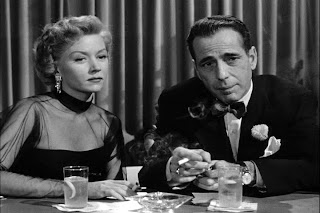

Also fascinating is how In a Lonely Place provides commentary on the effect that the Hollywood culture can have on those around it. This is a different interpretation from what is done in another 1950 classic, Sunset Boulevard. In that film, Wilder examines how Hollywood treats past stars, the people that are no longer profitable to those in power. In a Lonely Place looks at what can happen to entertainment personalities who are right in the middle of it all, trying to make a living and get by in that same world. It seems to show that even those who are finding work, who are still productive, can find it just as isolating as those that have been cast aside.

Little more needs to be said about Bogart’s performance – others have said it more articulately than I can. I still maintain that while Rick Blaine is certainly his most iconic role, his performance as Dix Steele is his best. Only Bogart’s turn as Fred C. Dobbs even approaches the same level of darkness seen in Dix. Watching him fight inner demons for the entire film is both unnerving and spellbinding. This is not necessarily a pleasant film to watch, but the craftsmanship on display from the Ray, the principle actors, and the great Burnett Guffey make it so powerful that you can’t help but return to it.

Thursday, February 11, 2010

#69: They Live by Night (Nicholas Ray, 1948)

Released: June 1948

Director: Nicholas Ray; Screenplay: Nicholas Ray and Charles Snee based on the novel “Thieves Like Us” by Edward Anderson; Cinematography: George E. Diskant; Music: Leigh Harline; Producer: John Houseman; Studio: RKO

Cast: Cathy O’Donnell (Keechie), Farley Granger (Bowie), Howard Da Silva (Chickamaw), Jay C. Flippen (T-Dub), Helen Craig (Mattie), Will Wright (Mobley)

When I first saw this debut film from maverick filmmaker Nicholas Ray, I wasn't sure exactly how much I liked it. Having seen countless “lovers on the run” films over the years, I was unsure of how this one stacks up against other greats – Bonnie and Clyde, Gun Crazy and other similar movies. I’m still not of the opinion that it ever reaches the level of either of those films, but comparing it to them can be a bit misleading. They Live by Night takes a slightly different angle on the general storyline, resulting in a much more sensitive, romantic tale.

Based on a novel that would later also be adapted for Robert Altman’s Thieves Like Us, the screenplay from Nick Ray and Charles Snee plots an ill-fated romance from its reticent beginnings to its tragic conclusion. Escaped prisoner Bowie (Farley Granger) falls for the young, naïve Keechie (Cathy O’Donnell), who is the niece of his partner Chickamaw (Howard Da Silva). After escaping from jail with Chickamaw and T-Dub (Jay C. Flippen), he decides to serve as the wheelman in their planned bank heist. Whereas Chickamaw and T-Dub plan this as the first in a long line of jobs, Bowie hopes to use his cut to retain a defense attorney to overturn his original sentence. When Bowie is hurt in the aftermath of the heist, he is returned to Keechie’s home where the young girl nurses him back to health. Falling for each other, the two young lovers decide to leave their past lives and start anew. Unfortunately, Bowie has been identified as one of the men involved in the bank job and a legend has begun to grow around him. Soon, he is being credited with pulling off jobs throughout the country, when in fact he is doing nothing but planning a marriage and normal life with Keechie. When Chickamaw tracks the newlyweds down, it means that they are on the run not only from the law but from their past associations. Chickamaw manages to convince Bowie to come along for one last job, to help his now-broke former partners. Feeling an obligation toward the two men who helped him escape from prison, Bowie reluctantly leaves his pregnant wife and attempts to finally free himself from his past.


The most striking aspect of the film is how it manages to be both tender and menacing. Once Bowie and Keechie go on the run, it essentially turns into a full-on romance story. Although it shows its datedness at times (the “I don’t know much about kissing” bits can be a little corny), the affection that quickly develops between the couple feels genuine. You can’t help but root for these two dreamers, both of whom are portrayed as victims of circumstance – Keechie for the family she is born into and Bowie for having a knack for getting situations into plans that quickly spiral out of his control. So when they finally arrive at something like a honeymoon getaway, it is striking to see their ideal family life shattered by the reentry of Chickamaw. Chickamaw, played brilliantly by Howard Da Silva, is like the bad penny in their lives, the man who neither of them can completely outrun. He is made all the more menacing by the fact that he seems to recognize this power – he knows that they will never be free so long as he is able to hound them, and he uses this leverage to manipulate Bowie. Da Silva is brilliant in this evil role.


This is also a fun one to watch knowing what Nicholas Ray would go on to do in his career. Many of the themes and techniques that Ray would explore throughout his later work can be seen here in his first outing as a director. Ray was a master at conveying a sense of isolation or exile. Similar to what he would do with his landmark Rebel Without a Cause seven years later, in They Live by Night he explores how outcasts try and make their own way in the world. The isolation that they experience along the way – whether true or imagined – can be seen in later work like Rebel, On Dangerous Ground, or even In a Lonely Place. The loneliness is handled differently in each case, but the tremendous sense of isolation is palpable in all of them. And one need only watch the opening aerial shot, following the prison-break getaway car, to recognize the storytelling through the camera that Ray would excel at throughout his career.

Wednesday, February 3, 2010

#77: On Dangerous Ground (Nicholas Ray, 1952)

Released: February 12, 1952

Director: Nicholas Ray; Screenplay: A.I. Bezzerides and Nicholas Ray based on the novel Mad With Much Heart by Gerald Butler; Cinematography: George E. Diskant; Music: Bernard Hermann, Paul Sawtell (uncredited); Producer: John Houseman; Studio: RKO

Cast: Ida Lupino (Mary Malden), Robert Ryan (Jim Wilson), Ward Bond (Walter Brent), Charles Kemper (Pop Daly), Anthony Ross (Pete Santos), Ed Begley (Capt. Brawley), Ian Wolfe (Sheriff Carey), Sumner Williams (Danny Malden), Gus Schilling (Lucky), Frank Ferguson (Willows), Cleo Moore (Myrna Bowers), Olive Carey (Mrs. Brent), Richard Irving (Bernie Tucker), Patricia Prest (Julie Brent)

- "You get so you don't trust anybody..."

OK, if the placement of Stray Dog failed to produce dismay, perhaps this one will? (BIG GRIN, particularly toward Sam, who I know is a champion of this one)

This Nicholas Ray film is an interesting entry in the countdown for me. When I originally sat down and made a tentative Top 100, trying to roughly map out the films that I would include, On Dangerous Ground was a borderline selection. Depending on how some recently acquired movies went over, there was at least the possibility that it would not even make the countdown at all. It was one that I knew that I needed to revisit, as it had been some time since my only viewing. The result should be pretty obvious, as it is here in the countdown and is nowhere near being borderline. It still likely remains much lower than a lot of readers will rank it, but in re-watching it I realized that it truly is another outstanding movie from Nick Ray.

Even more importantly for me as a noir fan, watching it for a second time made me realize something about my own appreciation of a particular actor – Robert Ryan. Earlier in the countdown, I had mentioned that I’ve never considered myself a big fan of Ryan’s. I still wouldn’t cite him as a personal favorite. But I did have an epiphany of sorts while watching him as hardened, bitter cop Jim Wilson. I realized that perhaps this is precisely the type of reaction that a lot of his roles are meant to elicit. While Ryan is usually the nominal hero of his films, he tends to play characters that are not very pleasant. So it would only be natural that Ryan and his characters do not have the same sort of restrained cool of Bogart or the casualness of Mitchum. Maybe his performances are actually so good that my leeriness of his characters is actually high praise? I’m still not completely certain where I come down in answering this question, but it’s an interesting thought that came to me about midway through this film.


Ryan’s Jim Wilson is an embittered officer who has been reprimanded by the department on a number of occasions for excessive use of force. After yet another incident of beating a confession out of a prisoner, his superiors decide to get him out of the city to assist on a murder investigation in a nearby rural town. It is a striking change of scenery, as the early parts of the film have a gritty, realistic feel of patrolmen on the beat, cruising the crime-ridden streets of the big city. Wilson is then sent to a snow-covered countryside, hunting a killer that could be roaming any of the nearby farms. Wilson goes on the hunt, alongside the shotgun carrying father of the slain girl (Ward Bond), and eventually follows the killer’s trail to a house inhabited only the blind Mary Malden (Ida Lupino). Mary is the killer’s sister, and after first trying to cover for her brother, she slowly begins to give up key details. Falling for the beautiful lady, Wilson becomes torn between ruthlessly hunting down the killer, as he normally would, and protecting the interests of Mary.

This is a gloomy, lonely film the entire way through. Even in the early scenes, when the camaraderie displayed by the three cops working together is obvious, Wilson makes sure to keep his friends at arm’s length. The second half gives the comparison between the loneliness of Wilson, brought on by psychological pressures, with the loneliness felt by Mary due to her physical ailments. While Mary doesn't display the bitterness always shown by Wilson, it is still obvious that she too is restless about the situation she finds herself in – fending for herself on a remote farm, trying to manage a mentally unstable brother. Ward Bond gives an admirable performance as well, but the chemistry between Ryan and Lupino that works best.


Well, that works best as far as acting goes. The greatest achievement of the film is actually Bernard Hermann’s score. Many consider it his greatest work. I don’t go that far, as he has other classics to his credit, but he provides stirring music throughout.

After singing its praises during this write-up, why then is this one ranked at #77 and not much higher? I can’t exactly put my finger on it. It just lacked a small something to enter the category of “great” for me. I still am somewhat given pause by Wilson’s abrupt change of personality upon meeting Mary, without any real progression toward his new, understanding way of thinking. But it’s a far better film that I originally judged it and reinforces my admiration for Nicholas Ray.