Showing posts with label Huston. Show all posts

Monday, June 21, 2010

#20: John Huston


- "Hollywood has always been a cage... a cage to catch our dreams."

I am in no way suggesting that John Huston should be classified as an “underrated” director. How could he be, considering that a number of his top films are rightly regarded as being among the finest ever produced in Hollywood. I do think, though, that his top two or three movies (and I suppose his role in Roman Polanksi’s Chinatown) are viewed as a complete summary of the man’s extraordinary career, which is a shame because there is so much more there. To be certain, his most famous pictures – The Maltese Falcon, The Treasure of the Sierra Madre, The Asphalt Jungle – deserve all of the acclaim that they receive. I love every one of them. But his lesser-known films are of such high quality, it amazes me that they are not more widely praised. The Misfits receives publicity because of the stars attached to it – it was the final film for both Marilyn Monroe and Clark Gable, and Montgomery Clift gave one his final performances, and Arthur Miller penned the screenplay – but it deserves recognition as the equal of Huston’s best work. Fat City is one of the four or five best boxing films ever made. The Dead is beautifully poetic. The Night of the Iguana might be my favorite screen adaptation of Tennessee Williams.

This is a man who continued making outstanding films for over forty years, remaining interesting through every phase.

Most of Huston’s films have a general vibe or feeling that make it known that he is the guiding force of his projects. I have seen his auterist credentials questioned, but I rarely have trouble recognizing Huston's style. His movies may not have been personal, but they contained similar threads that stamped them as John Huston films. Part of this I’m sure is due to the fact that, at least early in his career, he almost always had a hand in writing the scripts that he directed. His talents as a writer deserve nearly as much praise as those as a director. Being involved in projects from this early stage allowed Huston to instill a trademark understated cynicism to every film. It isn’t cynicism like one gets from a Billy Wilder film, where Billy is poking fun at everyone and everything. It is a cynicism where a fateful break, a stretch of bad luck, or good old ironic twists triumph in the end. His heroes come oh-so-close to fairytale endings, but never quite get there. Is it a pessimistic view? Some could read it that way, but to me it just feels realistic.

A connection to a modern director that I always think about is a lineage from John Huston and his early crime genre work and current crime film specialist Michael Mann. Both men set up great set pieces centered on heists and mysteries, but both Huston and Mann are more interested in examining why the participants are involved in the schemes and what compels them to take such risks. The heists or action is just the means by which they can examine their main characters.

1. The Treasure of the Sierra Madre (1948)
2. The Asphalt Jungle (1950)
3. The Maltese Falcon (1941)
4. Fat City (1972)
5. The Night of the Iguana (1964)
6. Key Largo (1948)
7. The Misfits (1961)
8. The Red Badge of Courage (1951)
9. The Dead (1987)
10. The Man Who Would Be King (1975)
11. The African Queen (1951)
12. Heaven Knows, Mr. Allison (1957)
13. Under the Volcano (1984)
14. Wise Blood (1979)
15. In This Our Life (1942)
16. The Unforgiven (1960)
17. Beat the Devil (1953)
18. Prizzi’s Honor (1985)

Up next, a man who dabbled in many styles and produced classics in all of them: Anthony Mann.

Thursday, April 15, 2010

#10: The Asphalt Jungle (John Huston, 1950)

Released: May 23, 1950

Director: John Huston; Screenplay: Ben Maddow and John Huston based on the novel by W.R. Burnett; Cinematography: Harold Rosson; Music: Miklós Rózsa; Producer: Arthur Hornblow, Jr.; Studio: MGM

Cast: Sterling Hayden (Dix Handley), Louis Calhern (Alonzo D. Emmerich), Jean Hagen (Doll Conovan), James Whitmore (Gus Minissi), Sam Jaffe (Doc Riedenschneider), Marilyn Monroe (Angela Phinlay), John McIntire (Police Commissioner Hardy), Marc Lawrence (Cobby), Anthony Caruso (Louis Ciavelli), Barry Kelley (Lt. Ditrich), Brad Dexter (Robert Brannom)

- “Crime is only a left-handed form of human endeavor…”

The countdown now comes to the movie which all post-1950 heist films can trace back their lineage. Whether it is The Killing, Reservoir Dogs, The Usual Suspects, or really any similarly themed crime caper, they all owe a debt to The Asphalt Jungle. Regardless of all of the fantastic movies that have come in its wake – and I consider the first two I just listed to be masterpieces – the argument can be made that The Asphalt Jungle remains the greatest heist film ever made. Watching it again made me rediscover why it was one of the first movies that I went into consciously aware of it being a “noir classic” and coming away completely satisfied. The Asphalt Jungle and Out of the Past are the two films that converted me into a noir junkie. So I take great pleasure in slotting The Asphalt Jungle into the Top 10 of the entire series.

Much of the originality of the movie might be lost on the current generation, or at least overlooked by those without knowledge of the omnipotent Hays Code that governed Hollywood productions. One of the key tenets of the Code decreed that “methods of crime were not to be explicitly presented,” which would seem to have prevented W.R. Burnett’s novel from ever being adapted for the screen. John Huston proved very adept at sidestepping potential Code violations – just watch The Maltese Falcon again if you don’t believe me – and once more showed that he could finesse a script and film into getting approval. Rather than focusing on the actual heist as the centerpiece of the film, the script from Huston and Ben Maddow instead make the focus on the disparate characters that make up the heist team. We learn about their lives, their struggles, and why they join the caper. This humanizing feature ran the risk of violating another element of the Code – that of portraying criminals in a sympathetic light – but this is deftly sidestepped as well. As any fan of noir knows, even criminals with the best of intentions, will eventually be made to pay for their lapses.


It is the classic heist gone wrong scenario. Recently released prisoner Doc Riedenschneider (Sam Jaffe) emerges from jail with a plan for an elaborate jewel heist. Realizing that he is going to need proper funding to implement the plan, he approaches high-profile attorney Alonzo D. Emmerich (Louis Calhern), a shady character who hovers around the underworld, to back him. He gets to Emmerich through rising bookmaker Cobby (Mark Lawerence), who is also drawn into the plan. As further muscle is needed, they begin bringing in more hoods. Hunchbacked knockaround Gus Minissi (James Whitmore) is hired as the wheelman and he in turns brings aboard Louis Ciavelli (Anthony Caruso) to crack the safe. Completing the team is struggling hoodlum and tough guy Dix Handley (Sterling Hayden), whom Doc personally chooses after liking what he sees from Dix in interactions with Cobby. What transpires as a result of the intricate planning is a heist that barely succeeds and then a minefield of plotting and double-crosses to see who will end up with the hot jewels.

Every key player in the film can make a legitimate case to turning in the best performance. I won’t declare this Hayden’s best performance – he has far too many memorable noir personalities to his credit – but in Dix Handley he perfected the kind of good-natured thief that so many other actors of the era strove to achieve. Doc Riedenschneider’s calm, calculating nature is unforgettable and Sam Jaffe infuses him with the necessary iciness. Mark Lawrence’s Cobby is the shifty, nervous bookie that is hard to ever get a handle on. James Whitmore makes Gus, the ever-loyal underworld everyman, as sympathetic as a wheelman has ever been. And tying it all together, pitting himself against everyone else, is Louis Calhern as Emmerich. It’s a unique performance in noir, to portray the powerful crime lord as a timid lawyer, but Calhern has the kind of distasteful regalness to make it work. Although the studios tried to make it seem otherwise after her bursting popularity, Marilyn Monroe plays the most minor of roles here.


What is so humanizing about these men are the bonds formed between the criminals. What everyone will notice is that the major scheming comes from the semi-legitimate attorney. He thinks that he can outsmart the smalltime crooks and make off with the jewels himself. But the true street guys – men like Dix, Gus, Louie and Doc – quickly develop bonds that seem unbreakable. They are not going to turn on each other. To do so would go against the codes that they have lived by. This lasting loyalty is responsible for some of the best scenes in the entire film. Gus, in particular, makes you forget that he is a career criminal – he just seems like a friend who would always go to the mat for those that he cares for. It is wrenching to watch him listening to the screams of longtime friend and partner Louie, shot through the belly and dying after the robbery. Although not as dreadful, I also love the scene when Gus scrambles to get hold of Dix to warn him about impending police raids. He speaks as rapidly as he can, ignoring the approaching patrolmen, realizing that he is going to get picked up but not wanting to leave his partner in the lurch. Is this a romanticized reading of criminal actions and loyalty? Sure it is, but I am forever fascinated by any strong bonds of friendship, particularly when the stakes are as high as they become in this film.

Huston’s direction is brilliant, particularly in the lack of flourish in the robbery. The robbery sequence here never comes close to matching the technical genius of the later Rififi, but it is used for an entirely different effect. The entire thing takes about ten minutes of screen time, which means sharp bursts intensity rather than the seething anxiety in Rififi. The aftermath of the theft, as a perfectly-planned robbery fails due to the kind of squabbling and backstabbing that plagues all street criminals, is what is most important. This aspect – along with some mandated moralizing from the police commissioner – is likely why censors green-lighted the movie to begin with. But with Huston guiding it, the criminals being brought to justice one-by-one never feels like a copout. It feels like a noir should.


Add in classy photography from Harold Rosson and a very impressive score from Miklós Rózsa and you have an all-time great movie, with one of the classic closing shots in all of noir. It is not the best film in the countdown, but I fail to see a glaring weak spot in the entire thing.

Saturday, April 10, 2010

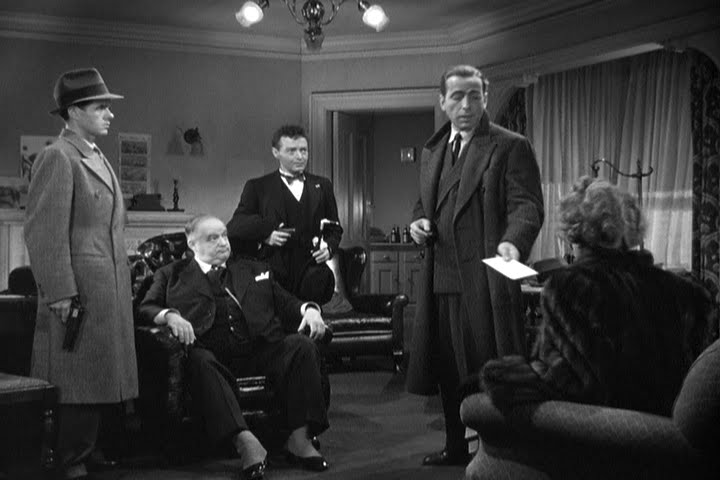
#15: The Maltese Falcon (John Huston, 1941)

Released: October 3, 1941

Director: John Huston; Screenplay: John Huston based on the novel by Dashiell Hammett; Cinematography: Arthur Edeson; Music: Adolph Deutsch; Producer: Hal B. Wallis; Studio: Warner Brothers

Cast: Humphrey Bogart (Sam Spade), Mary Astor (Brigid O'Shaughnessy), Gladys George (Iva Archer), Peter Lorre (Joel Cairo), Barton MacLane (Det. Lt. Dundy), Sydney Greenstreet (Kasper Gutman), Elisha Cook Jr. (Wilmer), Ward Bond (Det. Tom Polhaus), Jerome Cowan (Miles Archer), Lee Patrick (Effie Perine), John Hamilton (Bryan)

- “The stuff that dreams are made of…”

The film that is often acknowledged as kicking off the “classic noir cycle,” The Maltese Falcon remains a true treasure of American cinema. Does it possess all of the elements that one immediately looks for in film noir? Not necessarily – it is not nearly as dark, both in terms of look and content, as other classics. But it is so important in defining how the noir anti-hero is supposed to act and the moral ambiguity and flip-flops that these men must go through. Its legacy cannot be overestimated. Aside from helping to jumpstart that what would eventually become known as “film noir,” it was also the springboard for a number of other important moviemaking developments. It was the first film directed by John Huston, resulting in one of the most impressive debut films in Hollywood history. Also, while Humphrey Bogart was already a well-known quantity and his rise to stardom had already been started by High Sierra earlier in the year, this film is what put him into a whole other stratosphere of stardom. On these facts alone, The Maltese Falcon is rightly recognized as a landmark.

I think the quote that opens this write-up, which remains one of the most famous in the history of film, summarizes the entire production. As already mentioned, you have a director who has never been at the helm of his own major production. A leading man who was not the first choice – George Raft is actually said to have turned the role down. The story is based on a pulp novel that, for all of its merits, boasts a handful characters that could justifiably be labeled one-dimensional. How does the studio combat this? It puts together an absolutely dynamite cast to fill every role, bringing the characters to life. Peter Lorre and Sydney Greenstreet make characters like Cairo and Gutman some of the most unforgettable personalities ever committed to celluloid. The movie itself is confined to only a handful of sets, the bulk of it in a single room of an apartment, which is something that one would normally expect from a stage play. And yet never once does the movie feel like it is bound in anyway to the set, or anything else for that matter. Everything comes together for a wonderful, wildly entertaining picture. Truly the stuff that dreams are made of.


Bogart plays legendary Dashiell Hammett character Sam Spade, a private eye who owns an investigation firm with friend and partner Miles Archer (Jerome Cowan). When the two are hired to track someone for a mysterious Miss Wonderly, Miles is murdered. Determined to discover who killed his partner – not just out of friendship, but also so he is not set up for the crime – Spade is plunged into a world of international intrigue. Miss Wonderly turns out to actually be Brigid O’Shaughnessy (Mary Astor), a woman who has been traveling the world trying to track down a valuable treasure. The item she seeks is the Maltese Falcon, a statue of a bird that is encrusted with priceless jewels and gems. The danger arises out of the fact that she is not the only one that seeks the figurine. Other unscrupulous characters like Joel Cairo (Peter Lorre) and Kasper Gutman (Sydney Greenstreet) are also on the chase. Spade is thrown into the middle of everything, as he tries to fend off the police at the same time he tries to profit from the search for the missing falcon.


Every performance in this film sparkles, because they have to. Almost every moment of the film takes place indoors and all of the action is propelled by lengthy conversations between characters. The connection between all of the actors leaps off the screen, giving all of the bickering and conniving so much authenticity. Bogart has a number of characters for which he will always be celebrated, but next to Rick Blaine this is might be his most legendary. He _is_ Sam Spade. He makes Spade the prototype for how private eyes would be portrayed in cinema for at least the next thirty years. Peter Lorre and Sydney Greenstreet work together flawlessly, alternating between being allies and enemies. Cairo and Gutman may at times border on caricatures, but what does it matter when they are so much fun to watch. Great ensemble acting, combined with the unmatched cadence and snappiness of Hammett’s dialogue is arguably the greatest asset of the entire production. It is not all about the actors though, as director and cinematographer pull their weight as well. Director of photography Arthur Edeson uses bizarre camera angles and very low-key lighting to ensure that the simple sets never become boring. The shadows that run deep into the background are striking, giving the impression that there is some intense source of light emanating from the floor. This effect is accentuated by camera angles and placement where the camera is situated at ground level, looking up at the characters as they converse.


Even with all of this going for it, what ultimately elevates The Maltese Falcon to greatness is, in my opinion, the fact that what should be nothing more than a simple mystery is made into an interesting character study. The falcon is the ultimate McGuffin and once you realize that they are all chasing an object they are never going to capture, it becomes interesting to try and understand what motivates each person. Obviously, the most interesting of them all is Spade. The first time you see the movie, it really is difficult to get a handle on where he stands until the very end. Is he with Brigid or only out for himself? Is he searching for Miles’ killer or just trying to save his own skin? It almost seems like Spade himself doesn’t know the answers to these questions, which only makes him all the more intriguing as he gets drawn in deeper.

Sunday, February 7, 2010

#73: Key Largo (John Huston, 1948)

Released: July 16, 1948

Director: John Huston; Screenplay: Richard Brooks and John Huston based on a play by Maxwell Anderson; Cinematography: Karl Freund; Music: Max Steiner; Producer: Jerry Wald; Studio: Warner Brothers

Cast: Humphrey Bogart (Frank McCloud), Edward G. Robinson (Johnny Rocco), Lauren Bacall (Nora Temple), Lionel Barrymore (James Temple), Claire Trevor (Gaye Dawn), Thomas Gomez (Richard “Curly” Hoff), Harry Lewis (Edward “Toots” Bass), John Rodney (Deputy Clyde Sawyer), Marc Lawrence (Ziggy), Dan Seymour (Angel Garcia), Monte Blue (Sheriff Ben Wade), William Haade (Ralph Feeney), Jay Silverheels (John Osceola), Rodd Redwing (Tom Osceola)

- "One Rocco, more or less, isn't worth dying for..."

Another case of a movie that is probably more properly labeled a gangster movie, but here I am going to flat out admit to being swayed by conventional wisdom that just naturally places Key Largo as a film noir. It’s a debatable point, but I don’t feel like expending the energy of debating whether or not to include it. My definition of film noir is large anyway, so this one ultimately has no problem in qualifying for this countdown. The resort atmosphere of the Florida Keys is certainly atypical for a noir, but the hurricane gives the shadowy lighting and darkness to lend it a noirish atmosphere. Plus, when it comes right down to it, it’s just too much of an enjoyable film for me to pass up the opportunity to write about it.

I’ve always been fascinated by how the stage play origins of the film are glaringly obvious, which is usually a negative. In the story, returning veteran Frank McCloud (Humphrey Bogart) visits the Key Largo resort owned by the family of a dead war buddy. There he meets the man's father (Lionel Barrymore) and widow Nora Temple (Lauren Bacall). While Frank is visiting, the resort is taken over by a group of gangsters led by the notorious Johnny Rocco (Edward G. Robinson) and his entourage which includes a number of minions and girlfriend Gaye Dawn (Claire Trevor. Due to the hurricane moving into Key Largo, he is forced to set up camp in the hotel. While Rocco holds Frank and the Temple family hostage, Frank slowly moves from not wanting to be involved in the situation to growing protective of Nora and James. The closed confines of the resort are vital to the success of the story. The claustrophobic feel seriously heightens the tension. It is an interesting dynamic that is created, with the deterioration of relations between the fugitive gangsters and resort owners mirroring the worsening of the weather outside. So while it quickly becomes obvious that with the exception of the outdoors scenery, we are essentially watching a play on film, it’s so well done that it never matters.


The key reason it doesn’t matter is because of the astounding level of talent involved. The great John Huston not only directs, he also co-wrote the adaptation of Maxwell Anderson’s play. While certainly not his best, it is still impressive work from Huston, as he had quite the stars to coordinate during production. In Edward G. Robinson, Huston was working with the most iconic of on-screen gangsters in his final gangster role. It would mark the first time that Robinson would work with Humphrey Bogart and not receive top-billing. The reason is obvious, as this is prime-era Bogart. In the previous six years he had a run of films as impressive as any actor in the history of cinema, among them: Casablanca, To Have and Have Not, The Big Sleep, and the same year’s The Treasure of the Sierra Madre. I’m not arguing that Key Largo is as good as any of those, but it’s impressive movie to keep his red hot 1940s run intact. This would also be the final film that he and wife Lauren Bacall would make together. The performances are as expected from both of them, but Houston was wise not to focus things entirely on the wildly popular duo. Robinson and Claire Trevor provide outstanding performances of their own, serving as a counterpoint to the harmony of Bogey and Bacall. Lionel Barrymore is also smooth in his role as the wheelchair-bound proprietor.


The tension builds to a well executed, if un-noirish conclusion. Even so, I quite like the realization that is made by McCloud at the finish. While far from the best of anyone involved, Key Largo remains a delightful film to watch and I definitely intended to find a place for it in the countdown.