Saturday, April 17, 2010

#8: Sunset Boulevard (Billy Wilder, 1950)

Released: August 4, 1950

a.k.a.: Sunset Blvd.

Director: Billy Wilder; Screenplay: Billy Wilder, Charles Brackett and D.M. Marshman Jr.; Cinematography: John F. Seitz; Music: Franz Waxman; Producer: Charles Brackett; Studio: Paramount Pictures

Cast: William Holden (Joe Gillis), Gloria Swanson (Norma Desmond), Erich von Stroheim (Max von Mayerling), Nancy Olson (Betty Schaefer), Fred Clark (Sheldrake), Lloyd Gough (Marino), Jack Webb (Artie Green), Franklyn Farnum (Undertaker), Larry J. Blake (Finance Man #1), Charles Dayton (Finance Man #2), Cecil B. DeMille (Himself), Hedda Hopper (Herself), Buster Keaton (Himself), Anna Q. Nilsson (Herself), H.B. Warner (Himself), Ray Evans (Himself), Jay Livingston (Himself)

- “I _am_ big… it’s the pictures that got small…”

Man, would I give anything to be able to hop into a time machine and go back to see firsthand the incensed reactions of entertainment insiders when they initially encountered Billy Wilder’s Sunset Boulevard. In one of the crowning achievements of his career, the accomplished Wilder turned his bitingly cynical perspective and wit on the very industry that he had become a leading figure in. The apocryphal stories that exist about some of the reactions from Hollywood players are not only hilarious to recount, but telling of how close to home the biting script hit for many of the city’s powerbrokers. Louis B. Mayer was said to have become so incensed after watching the film at Paramount’s initial screening that he approached Wilder and berated him, heatedly asking how he could make such a mockery of the industry that had made him. When these pleas failed to get through, Mayer was rumored to have tried to pool funds from other studio heads to purchase the film negatives and destroy them before they were released. Some contemporaries of star Gloria Swanson’s silent days were offended by the portrayal, thinking that it cast them all in a ridiculous light. Looking at things now, sixty years removed from its initial release, it is possible admit that the biting script Wilder authored with Charles Brackett and D.M. Marshman falls short of indicting everything about Hollywood, as was initially accused. But it comes very close to doing so, pointing out, as only Billy Wilder could, how unmerciful the movie industry could be.


Is it a depressing drama? Is it a comedy? A complete farce? Is it even a film noir? In all honesty, as are the best Wilder films, it’s probably a little bit of all these things. Whatever labels you apply to it, though, there’s no denying its greatness. Everything about it – from writing, to directing, to acting, to photography – is damn near flawless. The reason this one is not #1 is purely because of personal preference – I love it, but I slightly prefer a few others – because this might be the best made film in the entire countdown.

The story centers on two people struggling to remain relevant in Hollywood. Joe Gillis (William Holden) is a former newspaperman from Dayton who moves to L.A. in hopes of making a career as a screenwriter. After a few minor successes, his career begins floundering to the point that he is unable to pay the rent or afford the payments on his car, which is in the process of being repoed. The other key figure is Norman Desmond (Gloria Swanson), a former star of silent films that at one time was the most popular actress on the planet. Her films were so successful that studios were built on the proceeds and in the process Norma herself accumulated a small fortune. But when talking pictures came into favor, Norma’s career was completely derailed. With her services no longer wanted, Norma went into seclusion on her Sunset Blvd. estate, living in a fantasy world, having contact with no one but her former director turned servant Max (Erich von Stroheim). The two cross paths when Joe swerves his car onto the Desmond estate while trying to avoid the repo men. When Norma learns that Gillis is a screenwriter, she floats the outlandish idea of the two working on a screenplay for her comeback. Joe plays along, hoping to earn some much needed cash, and stays on the estate rewriting the horrendous script that Norma had worked on for years. Things grow strange when the delusional Desmond develops a bizarre attachment to Joe, keeping him on the premises at all times and leading him to function as her male prostitute of sorts. So when Joe falls for another up-and-coming studio writer Betty Schaefer (Nancy Olson), the already fragile Norma completely loses it.


The authentic atmosphere of it all bears testament to the accomplishment of Wilder as both writer (along with longtime collaborator Charles Brackett) and director. I haven’t the slightest idea if Hollywood of this era was as petty and unforgiving as it is painted in this movie – my impressions of the studio system of this time come from films like Sunset Boulevard. So I have no clue if this is how the industry really treated past stars. What I do know is that Wilder makes me believe it to be true. After watching Sunset Boulevard – and particularly after hearing how people like Louie B. Mayer reacted – make me think that it _has_ to be true. Even with all of the theatrics and over-the-top performances, it is still that convincing. It has long been put forth that the genesis of the project stemmed from the sad tale of one-time titan D.W. Griffith, who by the 1940s was unsuccessfully begging for work in film. Wilder and Brackett saw this and were shocked, wondering what actually did happen to stars that had fallen from grace. This real-word connection, and its inclusion into the actual film, only adds to the authenticity. When you see what Gillis calls “waxworks” in the film played by the likes of Buster Keaton and Anna Q. Nilsson, even if they aren’t necessarily playing themselves, it carries a ring of truth.

The number of memorable scenes that make up the film are almost too countless to name. Is there a more unforgettable opening sequence? Our narrator leads us to his final resting place, letting the audience know that the body they see floating in a pool is his. Norma descending the stars for her close-up. Joe’s first glimpse of the grounds that make up Norma’s mansion is technically flawless, proving once again that the team of Wilder and director of photography John Seitz were among the finest duos in Hollywood history. If John Alton is the greatest cinematographer to ever work in noir, then surely Seitz has to be a shoo-in for the runner-up position. And it’s not just individual scenes that give the film such charm. It’s the minor touches that Wilder and company add to it all. It is things like the organ in Norma’s parlor that howls as the breeze hits its pipes. It’s the wonderful effect of something as simple as turning on the light in Norma’s recently restored pool. Minor details like these stick with you as much as the great individual scenes.


I don’t have the space to properly address the quality of the performances from the principal actors, but fortunately other more accomplished writers have given them their due. What I will say is that the acting is completely on another level in comparison to nearly any other film. Gloria Swanson, whose career mirrored the similar fall of Norma Desmond, gives the performance of a lifetime. The case can be made that it’s the finest performance by an actress in Hollywood history. William Holden is wonderful as well, but the other role that I always fall for is Erich von Stroheim as the loyal Max. He too plays a character whose story mirrors his real-life experiences and does so with equally spectacular results.

Excuse me for the gushing, but it’s a movie that justifies such fawning. I would guess that everyone reading this has seen it, but if you haven’t, stop reading this now and do so immediately. If you realize that you are unsure whether you’re supposed to be laughing or horrified, then you’ll know that you have properly understood the movie.

Friday, April 16, 2010

#9: Rififi (Jules Dassin, 1955)

Released: April 13, 1955

a.k.a.: Du rififi chez les hommes

Director: Jules Dassin; Screenplay: Auguste le Breton, Jules Dassin and Rene Wheeler based on le Breton’s novel; Cinematography: Philippe Agostini; Music: Georges Auric; Producers: Henri Berard, Pierre Cabaud and Rene Wheeler; Studio: Pathé

Cast:
Jean Servais (Tony le Stéphanois), Carl Möhner (Jo le Suedois), Robert Manuel (Mario Ferrati), Jules Dassin (Cesar le Milanais), Marie Sabouret (Mado les Grands Bras), Janine Darcey (Louise le Suedois), Claude Sylvain (Ida Ferrati), Marcel Lupovici (Pierre Grutter), Pierre Grasset (Louis Grutter/Louis le Tatoué), Robert Hossein (Remi Grutter), Magali Noël (Viviane), Dominique Maurin (Tonio le Suedois)

- “I liked you, Macaroni, but you know the rules…”

In the long line of great heist films – one of which have appeared just two days ago – one of the most common nominees as the best of them all is this French noir from expatriate director Jules Dassin. But to pigeonhole it with such a designation is to overlook the true scope of this amazing film. The jewel heist definitely serves as the centerpiece of the story, but it is only an action-starter that allows Dassin to explore themes that he so often examined – the ideas of the strong bonds of friendship, honor among thieves, and, even more powerfully considering the course of Dassin’s own life, deception and double-crossing. The trials and tribulations of Dassin have already been discussed in previous entries for his films in this series, but it is worth pointing out that his experiences with HUAC and being chased from the United States still appear to have been a major influence on his work in 1955. I am not arguing that they served as a direct inspiration for a movie like Rififi, but the same darkness and cynicism that became even more apparent in his work when he first left the United States remained at the fore in making this film.


The protagonist of the film is Tony le Stéphanois (Jean Servais), a career hoodlum recently released from prison after serving five years. His longtime partner Jo (Carl Möhner) and associate Mario (Robert Manuel) approach him with a plan for a major jewelry heist. Tony at first rebuffs the offer, saying they could never pull it off. Later that same night he goes to see his former girlfriend Mado (Marie Sabouret), who has taken up with rival gangster and nightclub owner Pierre Grutter (Marcel Lupvici), and after a violent confrontation with her Tony changes his mind about the robbery. But he argues that rather than just taking the jewels in front displays, the gang should break in and hit the central safe. Concocting an even more elaborate plan, and bringing in safe specialist Cesar le Milanais (Jules Dassin), leads to one of the great on-screen robberies ever filmed. The robbery goes well, but the aftermath is a disaster for all involved. Tony’s rival Grutter learns that the gang was behind the sensational robbery and sees an opportunity to make off with the loot himself. Kidnapping Jo’s five-year old son, they hold him for ransom and demand that the jewels be turned over to them. Tony and Jo thus begin scrambling to find a way to save the boy and their score.

The central heist sequence is rightly celebrated for the skill with which it is filmed. For nearly a half-hour, Dassin utilizes almost no dialog and just sets the camera in places to watch the thieves work. It is satisfying to watch, because for the forty minutes leading up to this point, the audience has watched all of the preparation and planning that went into the robbery. It sounds bizarre to call it “satisfying” to watch hoodlums pull off an elaborate robbery, but it really is. Perhaps the satisfaction is derived from the realization that Dassin is keeping you enthralled for such a long stretch without any unnecessary dialog or tricks. And the silence makes the entire sequence so incredibly intense, it is impossible not to be on the edge your seat the entire time. Since you have seen the planning, you know what they intend to do. But having it come off without a hitch is another animal entirely. So when the men look at each other nervously as they try to silence the alarm or dig through the ceiling, you as the viewer are just as on edge.


With all that being said, it isn’t the heist scene that keeps me coming back to this film. That sequence never fails to impress me, but it’s not something that I would necessarily watch on a continual basis for sheer enjoyment. What engages me most about the story is the code by which these men live by. The underworld code is something that is almost more important to a man like Tony than is life itself. It is a world where partners are supposed to look out for each other. If one hood can help another, he should, even if that means taking the rap. Those that are arrested must keep their mouths shut, no matter what. And the penalties for breaking any of these tenets are severe. The sense of brotherhood and camaraderie that exists among those that share this distorted set of ethics like Tony, Jo, Mario and Cesar, is what makes the story so compelling. They all know the rules – paraphrasing what Hyman Roth would famously say twenty years later, this is the life they chose. Still, there is great drama in seeing a scene like the one in which Cesar, having ratted out his partners after being tortured by Grutter, apologizes to Tony for succumbing to the pressure. Tony nods, understanding, but knows that he has to avenge the betrayal. Equally as memorable is the scene when Mario and his wife are tied up and interrogated by Pierre and his henchman. The sudden change of heart from Mario's wife is unforgettable.


Rififi looks and feels precisely how a film noir should and it remains my favorite film in the illustrious career of Jules Dassin.

Thursday, April 15, 2010

#10: The Asphalt Jungle (John Huston, 1950)

Released: May 23, 1950

Director: John Huston; Screenplay: Ben Maddow and John Huston based on the novel by W.R. Burnett; Cinematography: Harold Rosson; Music: Miklós Rózsa; Producer: Arthur Hornblow, Jr.; Studio: MGM

Cast: Sterling Hayden (Dix Handley), Louis Calhern (Alonzo D. Emmerich), Jean Hagen (Doll Conovan), James Whitmore (Gus Minissi), Sam Jaffe (Doc Riedenschneider), Marilyn Monroe (Angela Phinlay), John McIntire (Police Commissioner Hardy), Marc Lawrence (Cobby), Anthony Caruso (Louis Ciavelli), Barry Kelley (Lt. Ditrich), Brad Dexter (Robert Brannom)

- “Crime is only a left-handed form of human endeavor…”

The countdown now comes to the movie which all post-1950 heist films can trace back their lineage. Whether it is The Killing, Reservoir Dogs, The Usual Suspects, or really any similarly themed crime caper, they all owe a debt to The Asphalt Jungle. Regardless of all of the fantastic movies that have come in its wake – and I consider the first two I just listed to be masterpieces – the argument can be made that The Asphalt Jungle remains the greatest heist film ever made. Watching it again made me rediscover why it was one of the first movies that I went into consciously aware of it being a “noir classic” and coming away completely satisfied. The Asphalt Jungle and Out of the Past are the two films that converted me into a noir junkie. So I take great pleasure in slotting The Asphalt Jungle into the Top 10 of the entire series.

Much of the originality of the movie might be lost on the current generation, or at least overlooked by those without knowledge of the omnipotent Hays Code that governed Hollywood productions. One of the key tenets of the Code decreed that “methods of crime were not to be explicitly presented,” which would seem to have prevented W.R. Burnett’s novel from ever being adapted for the screen. John Huston proved very adept at sidestepping potential Code violations – just watch The Maltese Falcon again if you don’t believe me – and once more showed that he could finesse a script and film into getting approval. Rather than focusing on the actual heist as the centerpiece of the film, the script from Huston and Ben Maddow instead make the focus on the disparate characters that make up the heist team. We learn about their lives, their struggles, and why they join the caper. This humanizing feature ran the risk of violating another element of the Code – that of portraying criminals in a sympathetic light – but this is deftly sidestepped as well. As any fan of noir knows, even criminals with the best of intentions, will eventually be made to pay for their lapses.


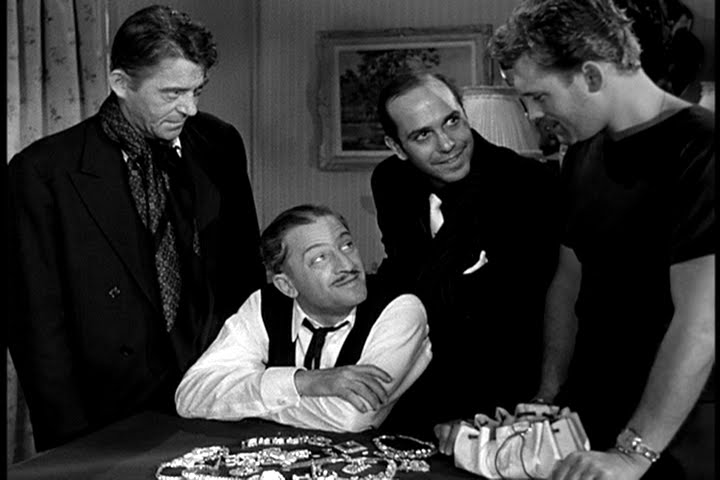
It is the classic heist gone wrong scenario. Recently released prisoner Doc Riedenschneider (Sam Jaffe) emerges from jail with a plan for an elaborate jewel heist. Realizing that he is going to need proper funding to implement the plan, he approaches high-profile attorney Alonzo D. Emmerich (Louis Calhern), a shady character who hovers around the underworld, to back him. He gets to Emmerich through rising bookmaker Cobby (Mark Lawerence), who is also drawn into the plan. As further muscle is needed, they begin bringing in more hoods. Hunchbacked knockaround Gus Minissi (James Whitmore) is hired as the wheelman and he in turns brings aboard Louis Ciavelli (Anthony Caruso) to crack the safe. Completing the team is struggling hoodlum and tough guy Dix Handley (Sterling Hayden), whom Doc personally chooses after liking what he sees from Dix in interactions with Cobby. What transpires as a result of the intricate planning is a heist that barely succeeds and then a minefield of plotting and double-crosses to see who will end up with the hot jewels.

Every key player in the film can make a legitimate case to turning in the best performance. I won’t declare this Hayden’s best performance – he has far too many memorable noir personalities to his credit – but in Dix Handley he perfected the kind of good-natured thief that so many other actors of the era strove to achieve. Doc Riedenschneider’s calm, calculating nature is unforgettable and Sam Jaffe infuses him with the necessary iciness. Mark Lawrence’s Cobby is the shifty, nervous bookie that is hard to ever get a handle on. James Whitmore makes Gus, the ever-loyal underworld everyman, as sympathetic as a wheelman has ever been. And tying it all together, pitting himself against everyone else, is Louis Calhern as Emmerich. It’s a unique performance in noir, to portray the powerful crime lord as a timid lawyer, but Calhern has the kind of distasteful regalness to make it work. Although the studios tried to make it seem otherwise after her bursting popularity, Marilyn Monroe plays the most minor of roles here.


What is so humanizing about these men are the bonds formed between the criminals. What everyone will notice is that the major scheming comes from the semi-legitimate attorney. He thinks that he can outsmart the smalltime crooks and make off with the jewels himself. But the true street guys – men like Dix, Gus, Louie and Doc – quickly develop bonds that seem unbreakable. They are not going to turn on each other. To do so would go against the codes that they have lived by. This lasting loyalty is responsible for some of the best scenes in the entire film. Gus, in particular, makes you forget that he is a career criminal – he just seems like a friend who would always go to the mat for those that he cares for. It is wrenching to watch him listening to the screams of longtime friend and partner Louie, shot through the belly and dying after the robbery. Although not as dreadful, I also love the scene when Gus scrambles to get hold of Dix to warn him about impending police raids. He speaks as rapidly as he can, ignoring the approaching patrolmen, realizing that he is going to get picked up but not wanting to leave his partner in the lurch. Is this a romanticized reading of criminal actions and loyalty? Sure it is, but I am forever fascinated by any strong bonds of friendship, particularly when the stakes are as high as they become in this film.

Huston’s direction is brilliant, particularly in the lack of flourish in the robbery. The robbery sequence here never comes close to matching the technical genius of the later Rififi, but it is used for an entirely different effect. The entire thing takes about ten minutes of screen time, which means sharp bursts intensity rather than the seething anxiety in Rififi. The aftermath of the theft, as a perfectly-planned robbery fails due to the kind of squabbling and backstabbing that plagues all street criminals, is what is most important. This aspect – along with some mandated moralizing from the police commissioner – is likely why censors green-lighted the movie to begin with. But with Huston guiding it, the criminals being brought to justice one-by-one never feels like a copout. It feels like a noir should.


Add in classy photography from Harold Rosson and a very impressive score from Miklós Rózsa and you have an all-time great movie, with one of the classic closing shots in all of noir. It is not the best film in the countdown, but I fail to see a glaring weak spot in the entire thing.

Wednesday, April 14, 2010

#11: The Third Man (Carol Reed, 1949)

Released: September 2, 1949 (UK)

Director: Carol Reed; Screenplay: Graham Greene based on his own novel; Cinematography: Robert Krasker; Music: Anton Karas; Producer: Carol Reed; Studio: British Lion Films

Cast:
Joseph Cotten (Holly Martins), Alida Valli (Anna Schmidt), Orson Welles (Harry Lime), Trevor Howard (Major Calloway), Bernard Lee (Sgt. Paine), Wilfrid Hyde-White (Crabbin), Erich Ponto (Dr. Winkel), Ernst Deutsch (Baron Kurtz), Siegfried Breuer (Popescu), Paul Horbiger (Karl)

- “In Italy for 30 years under the Borgias they had warfare, terror, murder, and bloodshed. But they produced Michelangelo, Leonardo da Vinci, and the Renaissance. In Switzerland they had brotherly love, they had 500 years of democracy and peace, and what did that produce? The cuckoo clock…”

The superlatives that have been heaped upon this film are impressive. Most agree that The Third Man is the finest British noir ever made (some proponents of Night and the City might slightly disagree). Some feel that accolade does not do justice to the greatness of this film – they say that it is the finest movie ever made in the UK. A few admirers will even go so far as to argue that this effort from Carol Reed is the best movie that has ever been made, in any nation, regardless of genre or classification. While I won’t go so far as to back up that final assertion, I can’t dispute the first two. It _is_ the finest of all British noirs. And it is _is_ the best film to be made in the UK that I have seen (although I do love Reed's The Fallen Idol as well, but no longer consider it The Third Man's equal). It is a complete master class in filmmaking, possessing all of the ingredients necessary for a great film. An enigmatic story and screenplay from the great Graham Greene provides the template for the talent. The acting is on-point throughout. The direction of Sir Carol Reed is damn near perfect. And the visuals and atmospherics that Reed worked to create with Robert Krasker are now legendary in the history of cinema.


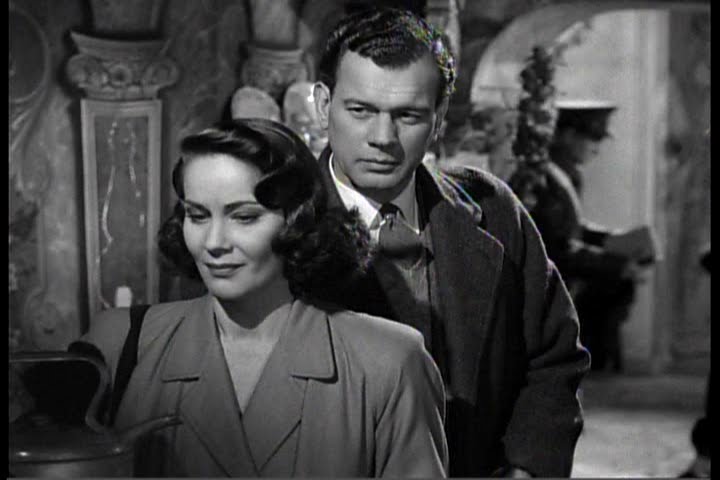
The story is likely one that everyone is familiar with. Holly Martins (Joseph Cotten) is an American writer of pulp western novels who travels to postwar Vienna at the behest of his friend Harry Lime (Orson Welles). When he gets to Vienna, Holly is stunned to learn that Harry has recently died. While attending his friend’s funeral, Holly bumps into Major Calloway (Trevor Howard), who warns Holly to leave Vienna and forget his old pal. Now even more intrigued, Holly decides to delve into the circumstances of Harry’s death and try to uncover what actually happened. The official story was that Harry was accidentally struck by a fast-moving automobile, but Holly is suspicious. Getting close to Anna Schmidt (Alida Valli), Harry’s former girlfriend, Holly is introduced to the cast of characters that last saw Harry before his death. The deeper his investigation goes, the more convinced Holly becomes that there was another witness – a “third man” – that has not come forward and might know more about the “accident” that killed Harry. At the same time, Major Calloway begins to give Holly clues about the type of person that Harry became, continually encouraging Holly to forget about him and leave Vienna. Holly soldiers on in his quest to vindicate his friend, but in the process uncovers something even more horrifying.

Greene’s story really is a treasure, as the majority of the film centers on an intriguing mystery, while eventually making that same mystery almost secondary. As the movie progresses, solving the mystery becomes less important than examining the bonds of friendship. How strong are such bonds? When do moral obligations trump a lifelong friendship? Holly wants desperately to believe that Harry is the same old pal that he has always known. As more facts concerning Harry’s activities are revealed to him, Holly still cannot accept the fact that his friend has turned into a human piranha. Holly feels that he has to vindicate his friend. When he finally comes face-to-face with Harry and tries to get answers, the friendship is strained to the limit.


This is another instance where rumors have continually swirled about Orson Welles actually having a role in directing. Certainly there are visual flourishes that one could picture Welles pulling off. But from everything that I have read, with both Welles and Carol Reed speaking on the topic, he definitely did not direct any part of the film. Welles only became attached to the project as an actor because he was strapped for cash in trying to make his own film. Which means that Carol Reed and Robert Krasker deserve all the praise in the world for the visual style of this film. It is an absolute landmark in cinematography and camera work. The surreal, slanted camera angles are the perfect counterpoint to the distorted, crooked machinations of the lead characters. The photography, with the starkest differences in lights and darks that one will see in noir, is as impressive as any film that will be included in this countdown. The scenes of the famed sewer chase are iconic – even people who are not familiar with The Third Man are likely to recognize the individual frames taken from that sequence.

But it is not just the visuals. The actors involved shine as well. Although he is on-screen for less than half of the film, the shadow of Welles’ Harry Lime hangs over everything, both literally and figuratively. The revelation of Harry standing in the darkened doorway, a sly grin across his face, is one of the great introductions of all time. Welles makes his limited time count, creating such a charmingly diabolical personality for Harry that the viewer almost hates the fact that they have to dislike him. The monologue at the beginning of this write-up was not actually in Greene’s screenplay and was famously added by Welles himself during filming. Regardless of its historical veracity or lack thereof (evidently Switzerland actually _was_ a military power at one point? Who knew…), it is a brilliant bit of writing and is delivered flawlessly by Welles. In another great historical irony, Welles was offered the option to take a salary for his work or be paid in a share of the movie’s profits. Needing the money, he chose the former. The movie then of course went on to be a huge success, costing Welles untold amounts of money. Such was his luck when it came to movies and finances. One also cannot overlook the contributions of Welles’ longtime collaborator Joseph Cotten, who played the sophisticated everyman as well anyone (Jimmy Stewart included). The assorted cast of Harry’s associates also turns in impressive work, as does the great Trevor Howard.


I’ll bring this one to a close now, just so it doesn’t look like I’m giving this movie more coverage than other entries – this is already one of the longer essays penned for the countdown. And yet, I still didn’t get to all of the key attributes of this great film – how can one overlook the unforgettable zither score from Anton Karas? It is just another wonderful element in the overall experience. This is cinema at its best.

Tuesday, April 13, 2010

#12: The Killing (Stanley Kubrick, 1956)

Released: May 20, 1956

Director: Stanley Kubrick; Screenplay: Stanley Kubrick and Jim Thompson based on the novel by “Clean Break” by Lionel White; Cinematography: Lucien Ballard; Music: Gerald Fried; Producer: James B. Harris; Studio: United Artists

Cast: Sterling Hayden (Johnny Clay), Coleen Gray (Fay), Vince Edwards (Val Cannon), Jay C. Flippen (Marvin Unger), Elisha Cook Jr. (George Peatty), Marie Windsor (Sherry Peatty), Ted de Corsia (Randy Kennan), Joe Sawyer (Mike O’Reilly), James Edwards (Racetrack Parking Attendant), Timothy Carey (Nikki Arane), Joe Turkel (Tiny), Jay Adler (Leo the Loanshark), Kola Kwariani (Maurice Oboukhoff), Tito Vuolo (Joe Piano), Dorothy Adams (Mrs. Ruthie O’Reilly)

Just as Quentin Tarantino is continually accused to ripping off this noir classic when he burst onto the indie scene with Reservoir Dogs, so too has Stanley Kubrick been accused of showing his influences a bit too much in making The Killing. There is no question that The Killing owes obvious debts to previously realized caper films, most particularly 1950’s The Asphalt Jungle and to a lesser degree 1955’s Rififi. Still, I always take exception to the idea that being influenced by a film, using similar stories or techniques, somehow automatically is morphed into ripping it off. Is The Asphalt Jungle a direct influence on The Killing? No doubt about it. But Kubrick’s film is so good, some would go so far as to argue that it tops even John Huston’s classic. I go back and forth and that topic, but I will say that I think Kubrick took a familiar story, told in a unique way, and that the end result is the tightest, most consistently entertaining film of his career.

Knowing the plots of any of the other movies mentioned above will mean familiarity with the story of The Killing. It is the story of the perfect heist gone awry, as the individual personalities and troubles of each member of the gang force the overall plan to crumble. The leader of the group is Johnny Clay (Sterling Hayden), a smalltime thief recently released from prison. He puts together a motley crew of co-conspirators to pull off a daring robbery at a local racetrack. The cast of characters brought together for the job is wide-ranging and each brings his own set of motivations and problems. There is the corrupt cop (Ted de Corsia) trying to pay off loanshark debts; George Petty (Elisha Cook Jr.), a teller at the track trying to make enough money to appease his cheating wife (Marie Windsor); the track bartender (Joe Sawyer) who is hoping to make enough money to care for his ailing wife; a gun-loving marksman (Timothy Carey) to shoot a horse in mid-race and create a diversion; Johnny’s longtime partner Marvin (Jay C. Flippen) who raises the necessary startup money to properly do the job; and even the wrestler Maurice (Kola Kwariani), another of Johnny’s old friends, is brought in to start a fight in the lobby. For his part, Johnny just wants to pull off this one last score and then run away with his sweetheart Fay (Coleen Gray).


What makes such a humdrum set up feel so fresh is the way that the story is told. It might seem passé now, but the nonlinear technique was not as commonplace in 1956 as it is today. Even now, having become used to it in modern movies, its use here has a certain freshness that keeps it from feeling like a gimmick. Kubrick opens the film with the actual robbery going down, then begins to jump back in time and follow each individual participant. We are introduced to each person, learn why they are engaging in the heist, and then follow them right up to the actual deed. Once a strand has been taken right to the verge of the robbery, the story then jumps back in time and picks up a different participant. It is a wonderful strategy to try and convey the countless machinations taking place simultaneously in the lives of everyone involved. George’s wife Sherry is plotting to have her boyfriend (Vince Edwards) end up with the loot. Randy is meeting with his loanshark (Jay Adler) promising he’ll have the money soon. Johnny is scrambling to tie up any loose ends in the planning. Rather than wildly jumping back and forth between these various threads, the style allows each subplot to be fully developed. The key to ultimately making everything work is the fact that each actor in every single subplot turns in an outstanding performance. The principals are universally solid, with Sterling Hayden and Elisha Cook Jr. in particular shining. The supporting actors, in limited screen-time, might be even more impressive. The nagging from Marie Windsor’s Sherry will be annoying even to viewers. Her boyfriend Val is the meathead who sees himself as Romeo. Kola Kwariani as the intellectual, chess-playing professional wrestler. Even Jay Adler, who is in the movie for mere minutes, is wonderful as the sympathetic loanshark, allowing his customer to slide a bit on his payments.

Still, it is likely Kubrick that will leave one most impressed. He was just 27 years old when The Killing was released, making only his third film as a director. It was also the first time that he had the opportunity to work with any kind of budget (albeit still a relatively small one), which allowed him to do a bit more than in his previous efforts. His keen visual sense was evident in 1955’s Killer’s Kiss, which at times looks nothing short of brilliant. The story, though, was severely lacking in that film. So for The Killing, he made the best decision in bringing in a skilled writer to help him with the script. The man he chose was pulp writer extraordinaire Jim Thompson, whose hardboiled stories have since come to be regarded as classics of the genre. I don’t know enough about specifics to say how much input Kubrick had in the screenplay, but the general consensus seems to be that Thompson was the reason that the story was so strong. At the very least Thompson deserves credit for the skillful dialogue that is rattled off in nearly every scene. Whatever the individual contributions of each man, the result is a script that is unbelievably tight. There is not a wasted moment in the entire film. It clocks in at just 83 minutes, which feels not a moment rushed or too long. It is perfectly paced.


And, oh my, those visuals. Kubrick and cinematographer Lucien Ballard create individual images that are frame-worthy. This incredible visual artistry would become a hallmark of his career, and he would have many future films that would be marvelous to look at, but for my money it’s hard to top the beauty of the black-and-white look of The Killing. It’s certainly not Kubrick’s top film in terms of greatness or influence, but it remains my personal favorite.

Monday, April 12, 2010

#13: Pitfall (André de Toth, 1948)

Released: August 24, 1948

Director:
André de Toth; Screenplay: Karl Kamb, André de Toth and William Bowers based on the novel by Jay Dratler; Cinematography: Harry J. Wild; Music: Louis Forbes; Producer: Samuel Bischoff; Studio: United Artists

Cast: Dick Powell (John Forbes), Lizabeth Scott (Mona Stevens), Jane Wyatt (Sue Forbes), Raymond Burr (MacDonald), John Litel (District Attorney), Byron Barr (Bill Smiley), Jimmy Hunt (Tommy Forbes), Ann Doran (Maggie), Selmer Jackson (Ed Brawley), Margaret Wells (Terry), Dick Wessel (Desk Sergeant)

At this point in the countdown, chances are that most of you can at least guess at reasonable final baker's dozen. The ordering might be up for debate, but I would be willing to bet that if you push came to shove, that every person following this countdown would at least know nine or ten of the remaining films that will be involved. Even so, the fun still remains in trying to figure out how they are going to be ranked against other classics. But… this one might keep folks from going a perfect 13-for-13. It is not an unknown quantity, particularly among those with a serious interest in noir, but Pitfall is far from being the household name that it deserves to be. It is a unique entry in comparison to most other films noir, as it unfolds not in the sordid underbelly of a major American city, but transports this same seediness to the most terrifying of places – the suburbs.

The film opens to the domestic bliss of postwar America, where a family sits down to breakfast – a wife preparing the meal, the father reading the morning paper at the table, a young child shattering on about the day at school. This is the situation that John Forbes (Dick Powell) finds himself in, with wife Sue (Jane Wyatt) and son Tommy (Jimmy Hunt). But rather than feeling the contentment that outsiders assume he must be experiencing, John feels restless. He is bored with the daily routine – a rut so predictable that he knows the precise minute that he will step off the train and be picked up by his wife for the drive home. John laments that the big dreams that he and his high school sweetheart Sue had when they were newlyweds have slowly been compromised for suburban tranquility. So when in the course of his work as an insurance agent he meets a gorgeous, exciting woman named Mona Stevens (Lizabeth Scott), he cannot resist the temptation to add a little excitement to his life. He originally meets Mona because he is trying to recover restitution from a robbery that his company paid the insurance on. Mona’s former boyfriend Bill Smiley (Byron Barr) pulled off the heist and hid some of the money by buying things for Mona. John goes to her in hopes of recovering these goods and recouping some of his firm’s losses. When he meets Mona, he is intrigued by her and decides to take up her invitation to go to dinner. As he grows fonder of her, he decides that he will cut some slack and allow her to keep a prized speedboat that Bill bought her. Under normal circumstances, it too would be seized by the company, but he makes an exception out of fondness for Mona.

Things would have remained secretive if not for the private eye the insurance company originally hired to track Mona. “Mack” MacDonald (Raymond Burr) is also smitten by Mona and is jealous of the affair that seems to be developing between her and John. MacDonald confronts John with evidence he gathers on his own – seeing the two of them together and, more importantly, his letting her keep the boat – and threatens to blow the lid off everything. This seems to bring John to his senses, as the affair is broken off. Things do not end there, though. When Mona continues to rebuff MacDonald’s advances, he figures he will get back at the her and John by letting the soon-to-be-released Bill Smiley know about the affair.


The interesting thing is that the affair seems to develop less because of romantic attraction between Mona and John than because of deficiencies in the lives of each person – with her former fiancé in prison, Mona is scared of being on her own and latches onto the steady John; John, on the other hand, just wants something to come into his life that will shake things up. There is obviously a connection between them, and maybe it is a little romantic, but it never once comes across as the kind of passionate affair that is at the center of so many noirs. While it can be inferred, it actually is never explicitly revealed that the relationship is ever consummated. But even if it is not as physical as one would expect, both Mona and John recognize how salacious just their being together in public could be. That is why they scramble when Mack begins threatening to bring this information public. Both are able to recognize that, in typical noir fashion, the damage has already been done simply by the two engaging in things like boat rides, dinners and late-night kissing. Thus, they are able to quickly decide that it is prudent to walk away from the relationship.

This is probably the most unique aspect of the entire film. In a typical film noir, Lizabeth Scott’s Mona Stevens would function as the traditional femme fatale and continue to pursue the married Forbes until his life is ruined. She actually does the opposite. When she finally discovers that John is married, _she_ comes to him and tells him how ridiculous it would be for them to continue their affair. It appears as if things can go back to normal and both can go their separate ways. Mack, of course, ensures that will never be able to happen. Still, what is important to recognize is the role that Mona plays in it. To those looking at it from the outside, it would be easy to classify her as a homewrecker, but she cuts off the affair precisely because she does not want to live with such a label. There actually is no femme fatale in the film – she inadvertently functions as a femme fatale would, tempting the nominal hero into actions that have serious repercussions. But she does so without full knowledge of the situation. The instant that she discovers what John is risking, she backs off. A strong case can be made that Mona is actually the purest character of them all that has either horrible taste or incredibly back luck when it comes to men.

The direction from de Toth and cinematography from Harry Wilds are far from groundbreaking. But there are a few scenes that are fantastic, particularly the late night stalking by Smiley and the subsequent shootout in the dark. On the whole, though, de Toth’s direction has a very detached feel to it. He puts the camera in the best place to take in the action and then just lets things unfold. It works though, because the three lead performances come close to being career bests. Dick Powell works as the cynical workingman. Lizabeth Scott was never better as the unlucky dame. Raymond Burr is at his menacing best. This is storytelling so strong and so well-acted that any possibility of a dated feel is irrelevant. Even if it is dated, it’s an interesting document of the infamous “postwar malaise” that runs as an undercurrent throughout so much work of the late 1940s and 1950s.

For those that have seen it, I’d be interested to hear thoughts on this question: is it the best films that André de Toth ever made? I think it is and I don’t hesitate to proclaim it so. For those that have not had the opportunity, seek this one out however possible. It is another unfortunate film that has no DVD release, but hopefully that will someday be remedied.

Sunday, April 11, 2010

#14: Touchez Pas au Grisbi (Jacques Becker, 1954)

Released: March 3, 1954

a.k.a.: Don’t Touch the Loot

Director: Jacques Becker; Screenplay: Jacques Becker, Maurice Griffe and Albert Simonin; Cinematography: Pierre Montazel; Music: Jean Wiener; Producer: Robert Dorfmann; Studio: Del Duca Films

Cast:
Jean Gabin (Max), René Dary (Riton), Dora Doll (Lola), Paul Frankeur (Pierrot), Jeanne Moreau (Josy), Michel Jourdan (Marco), Lino Ventura (Angelo), Marilyn Buterd (Betty), Daniel Cauchy (Fifi)

Although he gets plenty of respect on the various blogs and message boards that I frequent around the Internet movie community, French director Jacques Becker remains an unknown quantity to large segments of movie fans. Overshadowed by flashier, more technically-proficient contemporaries like Jean-Pierre Melville and Francois Truffaut, Becker nevertheless understood that fantastic storytelling would trump any technical achievements. And what a marvelous storyteller he was. Perhaps his stories are told conventionally, without much in the way of innovation or imagination with the camera, but this style fits his movies. Becker, at his best, dealt with men of the underworld who approached their criminal activity the same way that Becker approached his films – knowing what needs to be done and just doing it. No real frills. Simple as that and the results are spectacular. Becker seems to now be earning his justified respect thanks to efforts from companies like Criterion who have made his best films easily obtainable. I am not arguing that he was not highly thought of in his own lifetime, but until recently, his films have not be easy to get hold of in all parts of the world. So, I love the fact that I can draw even more attention to what I consider to be the best film that he ever made.


The great Jean Gabin is Max, a legendary gangster and thief renowned throughout the Parisian underworld. Growing older, Max is searching for one final lucrative score to send him, and his close friend Riton (René Dary), into retirement. Riton is a ne’er-do-well who survives the criminal lifestyle because Max has looked out for him ever since they started working together years before. He is not particularly well-liked or respected, but because he is with Max, Riton is also an important player. Max thinks that he has pulled off that one last job he was searching for, making off with $50 million in gold bars in a daring airport robbery. The entire city is wondering who pulled it off, so Max is unable to collect his profits just yet; he has to wait until the heat dies down a bit. Things grow complicated for Max when he is drawn into a feud between another gangster Angelo (Lino Ventura), a dope dealer, and nightclub owner Pierrot (Paul Frankeur). Max believes that he has mediated the dispute, recommending someone who both can accept to deal the drugs, but later that evening he catches some of Angelo’s men trying to bump him off. Now concerned, Max goes underground and tries to take Riton with him. But Riton’s girlfriend Josy (Jeanne Moreau) has been carrying on an affair with Angelo. Thanks to Riton’s need to talk himself up, he let slip to Josy that he and Max pulled off the Orly Airport robbery. Now Angelo not only wants to get Max and Riton out of the way, he also wants to recover the loot. When he kidnaps Riton, Max originally says that it is his own fault – Max is going to offer no assistance. But realizing that this goes against the underworld code that he has lived by for his entire life, Max decides that he must do whatever is necessary to bring his friend back alive.

Like other great French crime films of the era, the influence of American noirs and gangster pictures of the previous few decades is readily apparent. In fact, the influence here might come more from classic gangster pictures (The Public Enemy, Angels With Dirty Faces) than noir, but we’ve already cover how intimately related the two can be. Following the same delineation that Ward and Silver made in the Film Noir Encyclopedia, contrasting lead characters in gangster films versus film noir counterparts, I think the same applies here. Max may have used crime as way of rising to his luxurious lifestyle, but he knows exactly what he is. He is a gangster’s gangster, a man who others in the underworld come to consult on matters. The man who is looked up to as one of the great thieves in the city. A man who relishes planning major heists, pulling them off, and then unloading them through a fence. He lives this lifestyle to the fullest, sleeping in posh apartments, dining at the swankiest nightclubs and cavorting with gorgeous women. But, in the truest noir fashion, he recognizes that it won’t last – knows that it will be a short stint at the top. This is why he is so anxious to find that one last job, unload the merchandise, and go into his version of retirement. Does he think this will actually happen? At times, it appears that he genuinely does. At others, his commitment to the lifestyle and his criminal compatriots seems too much to simply leave behind. Gabin pulls off this vacillation as no one else would be able to. I know he has more famous roles, but this is how I always picture him, as Max the Liar. There is also great chemistry between him and those that he feels loyal to, mainly Riton and the brutal Pierrot. It is also interesting to see him facing off against archenemy Angelo, who is played by Lino Ventura.


If anyone questions how highly I rate Becker’s ability to tell a story, just watch the first half hour of this movie. At least for those thirty minutes it is a drama about friendship masquerading as a gangster film. We hear people talking about the fearsome Max, see mention made to the $50 million heist, but none of that is ever on display. Everything is made up of casual conversations between Max and Riton, Max and various women, Max and other knockaround guys at a local café. Nothing really happens and yet you are captivated the entire time. In the second half, Becker displays his ability to create a first-rate action movie, with a conclusion and final showdown that still impresses each time I watch. I know there are some people reading this who have not seen the film, so I’ll say no more concerning the second half of the film, except to acknowledge its brilliance.

Touchez Pas au Grisbi might be the finest French noir ever made. I actually consider it among the finest crime films ever made, noir or not, French or any other nationality.

Saturday, April 10, 2010

#15: The Maltese Falcon (John Huston, 1941)

Released: October 3, 1941

Director: John Huston; Screenplay: John Huston based on the novel by Dashiell Hammett; Cinematography: Arthur Edeson; Music: Adolph Deutsch; Producer: Hal B. Wallis; Studio: Warner Brothers

Cast: Humphrey Bogart (Sam Spade), Mary Astor (Brigid O'Shaughnessy), Gladys George (Iva Archer), Peter Lorre (Joel Cairo), Barton MacLane (Det. Lt. Dundy), Sydney Greenstreet (Kasper Gutman), Elisha Cook Jr. (Wilmer), Ward Bond (Det. Tom Polhaus), Jerome Cowan (Miles Archer), Lee Patrick (Effie Perine), John Hamilton (Bryan)

- “The stuff that dreams are made of…”

The film that is often acknowledged as kicking off the “classic noir cycle,” The Maltese Falcon remains a true treasure of American cinema. Does it possess all of the elements that one immediately looks for in film noir? Not necessarily – it is not nearly as dark, both in terms of look and content, as other classics. But it is so important in defining how the noir anti-hero is supposed to act and the moral ambiguity and flip-flops that these men must go through. Its legacy cannot be overestimated. Aside from helping to jumpstart that what would eventually become known as “film noir,” it was also the springboard for a number of other important moviemaking developments. It was the first film directed by John Huston, resulting in one of the most impressive debut films in Hollywood history. Also, while Humphrey Bogart was already a well-known quantity and his rise to stardom had already been started by High Sierra earlier in the year, this film is what put him into a whole other stratosphere of stardom. On these facts alone, The Maltese Falcon is rightly recognized as a landmark.

I think the quote that opens this write-up, which remains one of the most famous in the history of film, summarizes the entire production. As already mentioned, you have a director who has never been at the helm of his own major production. A leading man who was not the first choice – George Raft is actually said to have turned the role down. The story is based on a pulp novel that, for all of its merits, boasts a handful characters that could justifiably be labeled one-dimensional. How does the studio combat this? It puts together an absolutely dynamite cast to fill every role, bringing the characters to life. Peter Lorre and Sydney Greenstreet make characters like Cairo and Gutman some of the most unforgettable personalities ever committed to celluloid. The movie itself is confined to only a handful of sets, the bulk of it in a single room of an apartment, which is something that one would normally expect from a stage play. And yet never once does the movie feel like it is bound in anyway to the set, or anything else for that matter. Everything comes together for a wonderful, wildly entertaining picture. Truly the stuff that dreams are made of.


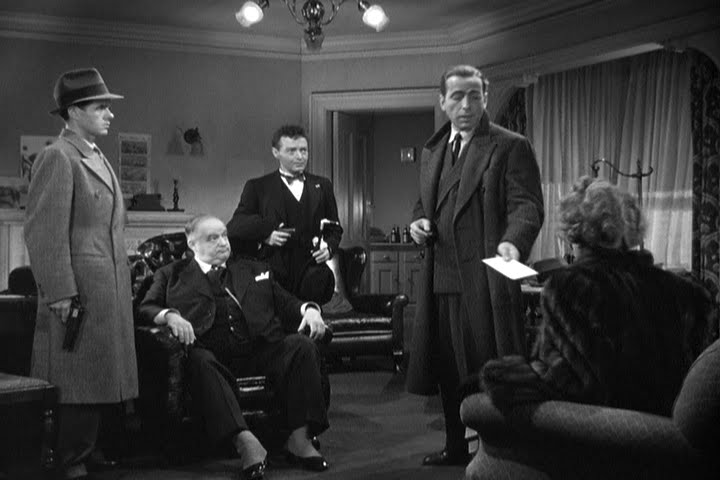
Bogart plays legendary Dashiell Hammett character Sam Spade, a private eye who owns an investigation firm with friend and partner Miles Archer (Jerome Cowan). When the two are hired to track someone for a mysterious Miss Wonderly, Miles is murdered. Determined to discover who killed his partner – not just out of friendship, but also so he is not set up for the crime – Spade is plunged into a world of international intrigue. Miss Wonderly turns out to actually be Brigid O’Shaughnessy (Mary Astor), a woman who has been traveling the world trying to track down a valuable treasure. The item she seeks is the Maltese Falcon, a statue of a bird that is encrusted with priceless jewels and gems. The danger arises out of the fact that she is not the only one that seeks the figurine. Other unscrupulous characters like Joel Cairo (Peter Lorre) and Kasper Gutman (Sydney Greenstreet) are also on the chase. Spade is thrown into the middle of everything, as he tries to fend off the police at the same time he tries to profit from the search for the missing falcon.


Every performance in this film sparkles, because they have to. Almost every moment of the film takes place indoors and all of the action is propelled by lengthy conversations between characters. The connection between all of the actors leaps off the screen, giving all of the bickering and conniving so much authenticity. Bogart has a number of characters for which he will always be celebrated, but next to Rick Blaine this is might be his most legendary. He _is_ Sam Spade. He makes Spade the prototype for how private eyes would be portrayed in cinema for at least the next thirty years. Peter Lorre and Sydney Greenstreet work together flawlessly, alternating between being allies and enemies. Cairo and Gutman may at times border on caricatures, but what does it matter when they are so much fun to watch. Great ensemble acting, combined with the unmatched cadence and snappiness of Hammett’s dialogue is arguably the greatest asset of the entire production. It is not all about the actors though, as director and cinematographer pull their weight as well. Director of photography Arthur Edeson uses bizarre camera angles and very low-key lighting to ensure that the simple sets never become boring. The shadows that run deep into the background are striking, giving the impression that there is some intense source of light emanating from the floor. This effect is accentuated by camera angles and placement where the camera is situated at ground level, looking up at the characters as they converse.


Even with all of this going for it, what ultimately elevates The Maltese Falcon to greatness is, in my opinion, the fact that what should be nothing more than a simple mystery is made into an interesting character study. The falcon is the ultimate McGuffin and once you realize that they are all chasing an object they are never going to capture, it becomes interesting to try and understand what motivates each person. Obviously, the most interesting of them all is Spade. The first time you see the movie, it really is difficult to get a handle on where he stands until the very end. Is he with Brigid or only out for himself? Is he searching for Miles’ killer or just trying to save his own skin? It almost seems like Spade himself doesn’t know the answers to these questions, which only makes him all the more intriguing as he gets drawn in deeper.

Friday, April 9, 2010

#16: The Postman Always Rings Twice (Tay Garnett, 1946)

Released: May 2, 1946

Director: Tay Garnett; Screenplay: Harry Ruskin and Niven Busch based on the novel by James M. Cain; Cinematography: Sidney Wagner; Music: George Bassman and Erich Zeisl; Producer: Carey Wilson; Studio: MGM

Cast: Lana Turner (Cora Smith), John Garfield (Frank Chambers), Cecil Kellaway (Nick Smith), Hume Cronyn (Arthur Keats), Leon Ames (District Attorney Sackett), Cameron Grant (Willie), Alan Reed (Ezra Liam Kennedy), Audrey Totter (Madge Gorland)

- “With my brains and your looks, we could go places…”

It’s the entrance that will grab you every time. Even if you’re not drawn in immediately on reputation, I defy you to watch the introduction of Cora Smith in The Postman Always Rings Twice and not at least find it alluring. Frank Chambers (John Garfield), a drifter who has just inquired about a job at the diner owned by Cora’s husband Nick (Cecil Kellaway), is sitting at the counter waiting on him to return. A tube of lipstick hits the floor and begins rolling toward his feet. The camera then switches to the point of view of Frank, as his gaze follows the path that the lipstick just traveled. He scans the small stretch of floor that the tube just rolled before being stopped dead in his tracks when he reaches the point of origin. The camera likewise stops, fixated on the well-formed legs of Cora Smith (Lana Turner). The shot stays there for a few moments, from high heels to calves, giving the shapely fixtures their due, before pulling back to reveal Cora standing in the doorway, the rest of her as gorgeous as the legs that just captivated the restless drifter. Without a single word, without anything resembling nudity or lewdness, the stage is set for a movie that is as erotic as was permissible at this time in Hollywood.


The story is toned down from the original novel by pulp master James M. Cain, a necessary decision in order for the project to get the green light and be in compliance with the Hays Code. But to strip this story entirely of its sexuality would be to completely gut the nucleus of it all, so what toning it down implied was taking any and all overt sexuality and finding more subtle ways to put it across. Rather than try anything drastic, director Tay Garnett and others in charge decided on the simplest road to success – find two leads that can sell it purely on the strength of their performances. Put together a couple whose sexual attraction and energy just oozes off the screen. With Lana Turner and John Garfield, they found a couple that fit this model perfectly.

It is now a familiar storyline, but when Cain first published his novel, the idea of a bored housewife conspiring with a boyfriend to murder her husband was downright salacious. The movie, although cleaned up from its source material, maintains the same filthy feeling. John Garfield is Frank, the drifter who can never stay settled in one place for any period of time. When he stops at Nick Smith’s diner he sees “man wanted” sign and inquires. Frank accepts the job, working at the lunch counter and gas station, but quickly finds that he has walked into a situation that he might not be able to handle. After his startling introduction to Cora, he soon realizes that he is unable to avoid an attraction toward her. At first, she completely dismisses him, but she too soon begins to fall for him. The closer they get, the more that they wish that Nick would simply disappear. Once they realize that won’t just happen by itself, they then begin to move – sheepishly at first, then much more aggressively – toward getting Nick out of the picture by any means necessary.


Deeper plot summary seems unnecessary here, as I’m guessing most have seen this one, or for those that haven’t that the plot will at least be familiar. There is no doubt that everything revolves around the murder plot and its aftermath, but there are so many other interesting subtexts throughout. The idea of postwar malaise is everywhere. Frank is the drifter whose feet “keep itchin’ for me to go places,” as he cannot find contentment in any one place. Likewise, Cora is constantly trying to move up and get away. She marries Nick because she sees it as a first step toward wealth and a better lifestyle. When these dreams aren’t quick to materialize, she begins scrambling for another way to get it – even if that means the dreadful plotting that she and Frank engage in. I have read complaints about Cora not being believable as the housewife of a diner owner, about how she is too glamorous for the role. I think that is the entire point - Cora _is_ out of place as a housewife and waitress. She didn't expect to still be in this position after years of marriage, which is why she is so anxious to concoct any scheme to get out.


The most interesting aspect of how the story is told is the ability of Garnett to make the audience almost root for the murderous couple. The connection between Frank and Cora is established very early in the film, before any of the nefarious plotting takes place. They are painted as a couple who might actually deserve to be together. Once this is established, it’s hard not to then begin hoping that things work out for them. At the same time, you don’t want to root for them because you know what they will eventually try and do. Cinematographer Sidney Wagner is not a name that gets mentioned very often, but he and Garnett photograph the film perfectly. Everything takes place at night, whether it is at the diner or on the beach, with the muted glow of the moon hanging above. They film the diner and house of the Smiths like a dungeon, serving both as a reminder of the entrapment felt by both Frank and Cora, and also foreshadowing what will eventually become of them. The constraining nature of the interiors are emphasized by Garnett’s use of close-ups and very little camera movement. This drives home the confined space which Frank and Cora have to try and carry on their secret romance.

There are supporting performances that shine as well – the squaring off of Hume Cronyn’s unscrupulous defense attorney Keats against District Attorney Sackett (Leon Ames) is interesting by itself. The two attorneys are determined to win the case, but do so with little regard to the actual victim and defendants. But make no mistake, the focus is never taken off the two central characters. Turner and Garfield shine in what should be one of the first noirs that any newcomer seeks out.

Thursday, April 8, 2010

#17: The Big Sleep (Howard Hawks, 1946)

Released: August 23, 1946

Director: Howard Hawks; Screenplay: William Faulkner, Leigh Brackett and Jules Furthman based on the novel by Raymond Chandler; Cinematography: Sidney Hickox; Music: Max Steiner; Producer: Howard Hawks; Studio: Warner Brothers

Cast:
Humphrey Bogart (Philip Marlowe), Lauren Bacall (Vivian Sternwood Rutledge), John Ridgley (Eddie Mars), Martha Vickers (Carmen Sternwood), Dorothy Malone (Acme Bookstore Worker), Peggy Knudsen (Mona Mars), Regis Toomey (Chief Inspector Bernie Ohls), Charles Waldron (General Sternwood), Charles D. Brown (Norris), Bob Steel (Lash Canino), Elisha Cook, Jr. (Harry Jones), Louis Jean Heydt (Joe Brody), Sonia Darrin (Agnes Lowzier), Ben Welden (Pete), Tom Fadden (Sidney), Trevor Bardette (Art Huck), Arthur Gwynn Geiger (Theodore von Eltz)

- “I collect blonds and bottles…”

OK, I’ll pose the question to you fine readers: Who did kill Sternwood chauffeur Owen Taylor? One of the most famous stories of Hollywood lore deals with this issue, as Howard Hawks and screenwriter William Faulkner (yes, that William Faulkner) couldn’t figure out how to explain this mystery. They figured they would go straight to the source and sent a wire to Raymond Chandler asking to solve the mystery for them. Chandler’s response? He didn’t have the foggiest idea. That story is apocryphal, but it highlights why The Big Sleep remains such an impressive film. Plot holes like this do nothing to damage the overall product. You don’t know how Owen Taylor was killed (even though I think I have a basic theory that works)? There are other details that don’t make sense? Who cares – there is so much fun to be had along the way that by the time you realize that some things aren’t adding up, it doesn’t really matter.


The story certainly is convoluted. It’s not necessarily incomprehensible, mind you, but it is likely to leave a first-time viewer scratching his or her head. The protagonist is Raymond Chandler’s legendary private eye Philip Marlowe (Humphrey Bogart). Hired by the rich General Sternwood (Charles Waldron) to investigate blackmail letters that are being sent concerning his youngest daughter Carmen (Martha Vickers). Carmen is a wild child who is known around Los Angeles as someone that paints the town and builds up massive gambling IOUs. Normally the General would have farmed the job out to his longtime protégé Sean Regan, but he has recently disappeared. Marlowe looks into the blackmailer, a bookstore owner named Geiger, which eventually pulls him into a maze that winds through the entire Los Angeles underworld. Along the way he also becomes involved with General Sternwood’s older daughter Vivian (Lauren Bacall), a vivacious and enigmatic socialite. Even as the two begin to fall for each other, it seems as if Vivian is constantly scheming behind Marlowe’s back.

The production history of The Big Sleep is equally as interesting and convoluted. Although not released until mid-1946, filming actually began in 1944 and was completed by January 1945. In Warner Brothers’ eyes, though, the timing could not have been worse. With World War II coming toward a conclusion, the studio had a number of war films in the vault still awaiting release. Fearful that if the war ended the audience would no longer be interested in war-themed films, they began to rush those to the screen and hold back movies that would not lose appeal by a delay. Thus, The Big Sleep was seen as a movie that could withstand such a wait. But by the time it finally was about to get its shot at the big screen, the Bogey and Bacall duo had become a wildly popular phenomenon. Jack Warner wanted to capitalize on this popularity and decreed that key scenes needed to be added or re-shot in order to do so. The end result of all this is that there are actually two versions of the film in existence – the theatrical release of August 1946 and the 1945 “pre-release” version, with slight variations between the two. Fortunately for modern audiences, the easily-obtainable DVD contains both versions, so each individual can form their own opinion as to which is superior. There aren’t necessarily any major differences, but I usually go for the theatrical cut whenever I watch it.


The reason I chose the ’46 version? The Bogey-Bacall interplay really was worth adding, even if it was the result of a studio dictating something to a director of Hawks’ stature. Although fans of Robert Mitchum can make a strong counterargument, there has never been a cooler on-screen presence than Humphrey Bogart. Whether he is playing Marlowe, Sam Spade, Rick Blaine, Fred C. Dobbs, or countless other roles, there is a an inherent hipness to everything that Bogart does. This is not to say that he is one-dimensional as an actor – the man could play damn near anyone. But there is certainly a “Bogart slant” to each of them. The closest I have ever seen in terms of a female possessing this same coolness is Lauren Bacall, whom Bogart married in 1945. So when the two are allowed to go toe-to-toe, they soak up every inch of the screen. Absolutely nothing else matters except the witty exchanges between Marlowe and Vivian. And, wow, what great exchanges they are. Raymond Chandler deserves huge kudos for the great dialog that he crafted in his original novel, but much praise also has to go to the incredibly talented screenwriting team in crafting the script. William Faulkner needs no introduction to anyone who has completed high school or read any American literature, and to any fans of classic cinema Leigh Brackett and Jules Furthman are close to writing royalty. Some of my favorite lines and exchanges:

Vivian: So you do get up, I was beginning to think you worked in bed like Marcel Proust.
Marlowe: Who's he?
Vivian: You wouldn't know him, a French writer.

------------------------------------------------------------------------------------
Marlowe: Come into my boudoir.
Vivian: You go too far, Marlowe.
Marlowe: Those are harsh words to throw at a man, especially when he's walking out of your bedroom.

------------------------------------------------------------------------------------
Philip Marlowe: You wanna tell me now?
Vivian: Tell you what?
Philip Marlowe: What it is you're trying to find out. You know, it's a funny thing. You're trying to find out what your father hired me to find out, and I'm trying to find out why you want to find out.
Vivian: You could go on forever, couldn't you? Anyway it'll give us something to talk about next time we meet.
Philip Marlowe: Among other things.


Not just noirs, but film in general doesn’t come much more entertaining than this. It might not be as dark as other classic noirs, but it is such an entrained part of noir history that it is an absolute essential.